Most people think of balance as something that lives in the legs or the inner ear. In reality, staying upright is one of the brain’s most constant jobs. Every second you stand, your brain is combining signals from your eyes, your inner ear and sensors in your joints and feet, then sending tiny corrections to your muscles. When that system is not working smoothly, you may notice dizziness, unsteadiness, or feeling “off” in busy places, even if a brain MRI looks normal.
In Episode 5 of Restoring Brain Health, Dr. Trevor Berry described computerized balance testing as “another great diagnostic, very sensitive test” within the brain function assessment at Brain Restore Centers. This article explains how balance works, what a computerized balance test measures, and what research shows about its value.
Balance is a brain skill
Your brain uses three main sources of information to keep you steady:
- Vision: your eyes tell you where you are relative to the room and the horizon.
- The vestibular system: sensors in the inner ear detect head movement and the pull of gravity.
- Somatosensation (proprioception): receptors in your feet, ankles and joints report pressure and position.
The brain constantly weighs these signals. On a firm floor in good light, you lean heavily on your feet and eyes. On a boat, in the dark, or on soft sand, the brain has to shift its reliance to whichever sources remain trustworthy. This ability to re-weight signals is called sensory integration, and it depends on healthy communication between several brain regions, including the brainstem and the cerebellum.
That is why balance can reveal more than whether someone wobbles. As Dr. Berry explained in the episode, by measuring sway under different conditions, clinicians “can extrapolate a lot of information as to what your nervous system might be” doing, including “where there’s some disconnect or some communication interference.”
What happens during a computerized balance test
During a computerized balance assessment, you stand on a platform that contains force sensors. In Dr. Berry’s words, “we stand you on a monitoring scale and it’s picking up all of your patterns of sway and movement.” The test is painless and non-invasive. A harness is often used for safety so that a loss of balance is not a fall.
Many systems are based on a method called computerized dynamic posturography. In a 1990 article in Neurologic Clinics, Lewis Nashner and James Peters described how this approach measures balance under controlled conditions and “complements and expands on” traditional tests of inner-ear function (Nashner & Peters, 1990).
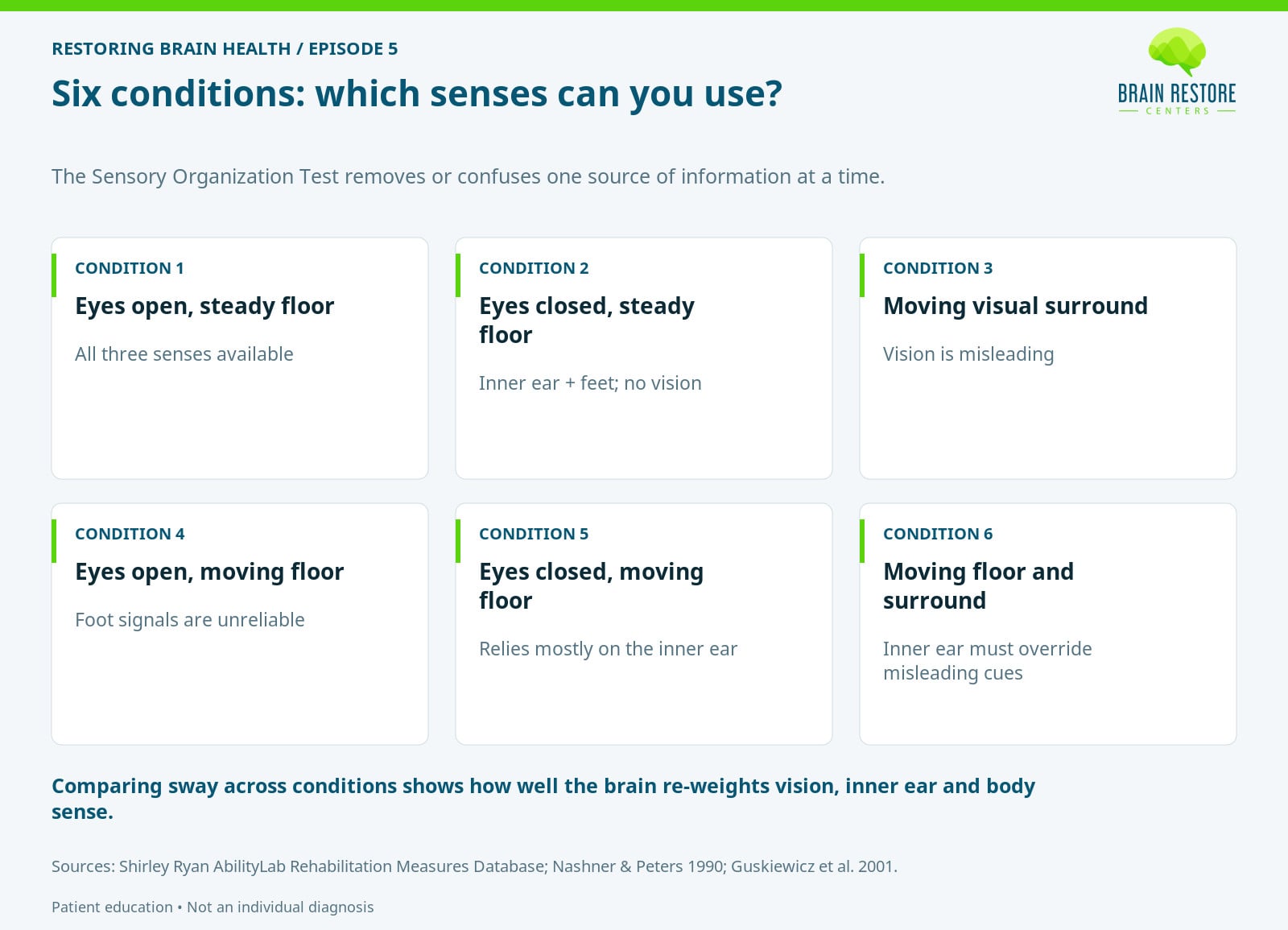
The best-known protocol is the Sensory Organization Test (SOT). It uses six conditions that systematically remove or confuse one sense at a time, by closing the eyes or by letting the platform or visual surround move slightly in step with your own sway (Shirley Ryan AbilityLab Rehabilitation Measures Database). Comparing your stability across conditions helps show which sources your brain relies on and where integration may break down.
What the results can suggest
The test produces scores for each condition and summary measures of how well you use each sense. Patterns can be informative:
- More sway when the eyes close can suggest greater dependence on vision.
- Difficulty when the surface moves can suggest the brain is relying heavily on information from the feet and has trouble switching to vision and the inner ear.
- Difficulty in the most challenging conditions can suggest the vestibular system and its brain connections are not being used effectively.
- Overreliance on misleading visual input can help explain why some people feel worse in grocery store aisles, crowds or scrolling screens.
These are patterns, not diagnoses. A balance test identifies how someone is struggling to stay stable. Working out why still requires a history, a neurological exam and often other tests.
What the research shows: balance after a concussion
Some of the clearest evidence for computerized balance testing comes from concussion research.
In a 2001 study published in the Journal of Athletic Training, Kevin Guskiewicz, Scott Ross and Stephen Marshall at the University of North Carolina tested 36 Division I college athletes who had a concussion and 36 matched controls. Using both the Sensory Organization Test and a clinical balance test, they found that injured athletes showed balance deficits the day after injury that were significantly worse than their preseason scores and those of controls. The authors concluded these deficits were likely the result of “not using information from the vestibular and visual systems effectively” (Guskiewicz et al., 2001).
A larger 2003 study in JAMA, the NCAA Concussion Study led by Michael McCrea, followed football players from 15 colleges. On average, balance problems measured with a clinical scoring system resolved within 3 to 5 days, while symptoms took about a week (McCrea et al., 2003). Those are average figures for young athletes. Recovery varies widely, and some people continue to have symptoms much longer, which is exactly when a broader assessment becomes valuable.
Guskiewicz’s 2001 review in the Clinical Journal of Sport Medicine summarized the bigger lesson: balance testing objectively assesses the motor side of brain function, and symptoms, thinking skills and balance “are not necessarily related or even affected to the same degree” (Guskiewicz, 2001). Measuring all three gives a fuller picture than any one alone.
Simple versus computerized balance tests
| Feature | Simple clinical balance checks | Computerized balance testing |
|---|---|---|
| Examples | Standing with feet together, single-leg stance, tandem walking | Force-platform posturography such as the Sensory Organization Test |
| What is measured | Whether you can hold a position, often counted by errors or time | Fine changes in sway, measured continuously |
| Sensory conditions | Usually eyes open versus closed, firm versus foam surface | Systematically changes vision, surface and visual surround |
| Strengths | Quick, inexpensive, available anywhere | Sensitive, objective and easy to repeat for comparison |
| Limits | Can miss subtle problems; depends on observer scoring | Requires specialized equipment; still needs clinical interpretation |
Both have a place. A bedside neurological exam includes simple balance and coordination checks, and the computerized test adds precise, repeatable measurement.
Why balance matters beyond concussion
Balance is closely tied to safety and independence. According to the CDC, more than one in four adults age 65 and older falls each year, and falling once doubles the chance of falling again. Yet fewer than half tell their doctor.
Dr. Berry noted in the episode that even when balance is not the main reason someone comes in, improving it can still be worthwhile, particularly as a fall-risk issue. Tracking balance objectively helps you and your care team see whether it is changing over time.
When to ask about a balance assessment
Consider asking about balance testing if you notice:
- Unsteadiness when walking, turning or getting up.
- Dizziness or a sense of motion in busy or visually complex places.
- Needing to hold on to walls, rails or furniture more than before.
- Balance changes after a concussion or other head injury.
- A recent fall or near-fall.
Sudden severe dizziness with weakness, trouble speaking, vision loss or a severe headache needs emergency care right away.
Part of a broader brain function assessment
At Brain Restore Centers, computerized balance testing is one of seven parts of a brain function assessment, alongside a detailed history, symptom index, neurological exam, MoCA cognitive screening, qEEG brain mapping and lab markers. Repeating the balance test during re-assessment helps show what has changed. Our mission is to help people understand how their brain is working today and measure progress honestly over time, so that unsteadiness is investigated rather than simply accepted.
This article is for general education, not individualized medical advice. Discuss persistent or worsening symptoms with a qualified healthcare professional.