The Montreal Cognitive Assessment, better known as the MoCA, is one of the most widely used brief tests of thinking skills in the world. It has appeared in news coverage of high-profile physical exams, and it is used in clinics, hospitals and research studies. If you or a family member has been asked to take one, you may be wondering what it measures, what the score means, and what happens next.
In Episode 5 of Restoring Brain Health, Dr. Trevor Berry described the MoCA as one of several standardized windows into brain function used at Brain Restore Centers. This guide explains how the test works, what the research shows, and how to make sense of a score without over- or under-reacting to it.
What the MoCA is
The MoCA is a one-page, pen-and-paper screening test that takes about 10 minutes. It was developed by Dr. Ziad Nasreddine and colleagues in Montreal to help detect mild cognitive impairment (MCI): changes in memory or thinking that are noticeable and measurable but not severe enough to interfere significantly with daily independence.
As Dr. Berry explained, the MoCA “is looking at memory recall, it’s looking at visual spatial processing, it’s looking at other frontal executive function.” It is scored out of 30 points. Because it is standardized, it can be repeated and compared over time, and because it touches many different skills, it can hint at which areas of thinking deserve a closer look.
Dr. Berry also noted that the MoCA can help “localize” where difficulties may be coming from. For example, trouble copying a cube points to visual-spatial processing, while trouble with word recall points to memory.
What the 30 points cover
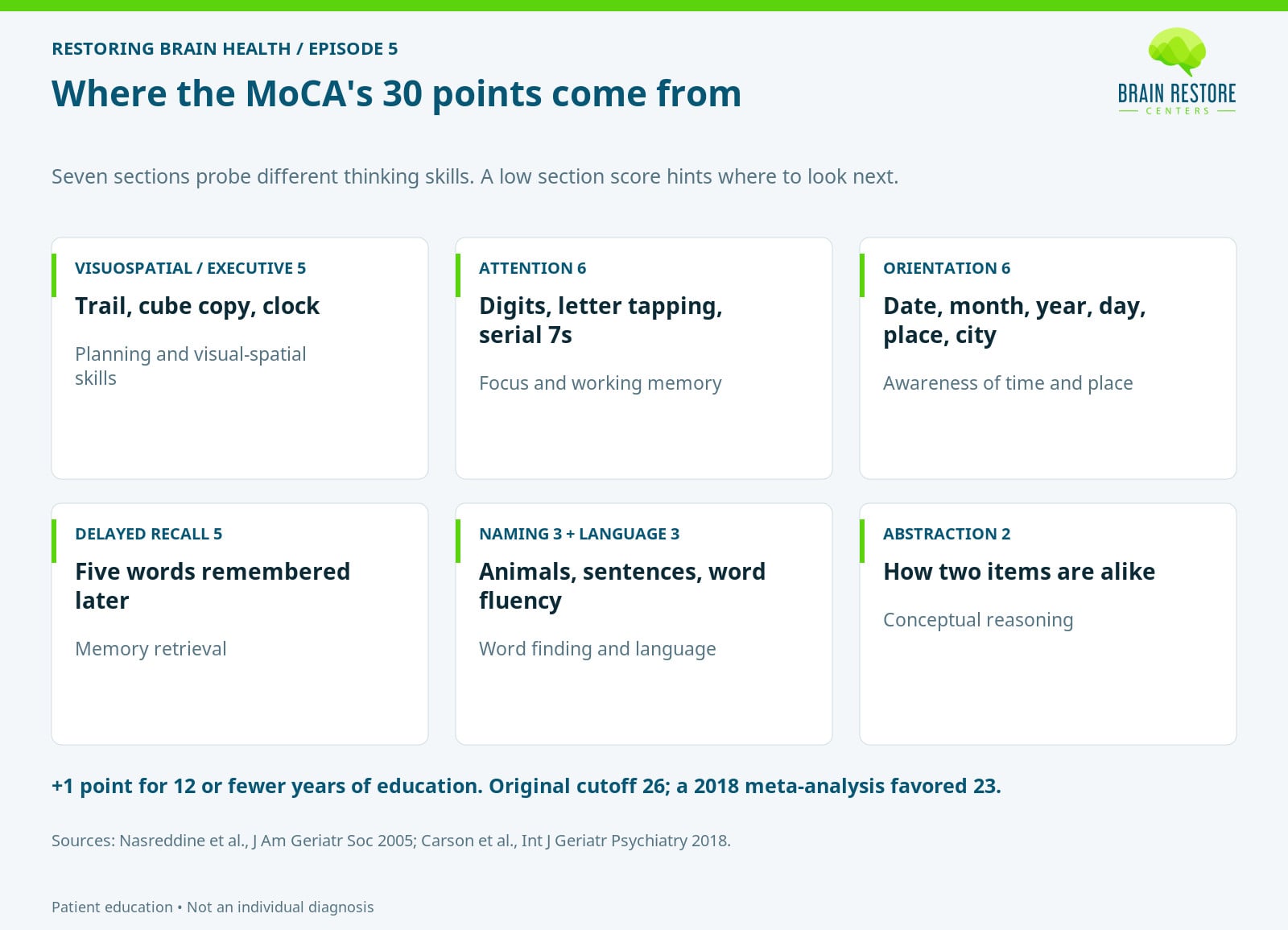
The test is organized into sections, each probing a different kind of thinking:
- Visual-spatial and executive skills (5 points): connecting numbers and letters in alternating order, copying a cube and drawing a clock set to a specific time.
- Naming (3 points): identifying three pictured animals.
- Attention (6 points): repeating number sequences forward and backward, tapping at a target letter, and subtracting 7 repeatedly from 100.
- Language (3 points): repeating two sentences and naming as many words as possible beginning with a given letter in one minute.
- Abstraction (2 points): explaining how two items are alike.
- Delayed recall (5 points): remembering five words learned earlier in the test.
- Orientation (6 points): naming the date, month, year, day, place and city.
One point is added for people with 12 or fewer years of formal education, up to the 30-point maximum. That adjustment is part of the original scoring.
What the original research found
In 2005, Nasreddine and colleagues published the first validation study in the Journal of the American Geriatrics Society. They tested 94 people with mild cognitive impairment, 93 with mild Alzheimer’s disease and 90 healthy older adults. Using a cutoff of 26, the MoCA identified 90% of the MCI group, compared with just 18% for the older Mini-Mental State Examination (MMSE). It identified 100% of those with mild Alzheimer’s disease, compared with 78% for the MMSE. Specificity was 87%, meaning some healthy participants also scored below 26 (Nasreddine et al., 2005).
That sensitivity to milder changes is why the MoCA became so popular. Many people with early, subtle difficulties score normally on less demanding tests.
Is 26 the right cutoff?
The original recommended threshold for a “normal” score was 26 or higher. Later research looked at whether that cutoff works equally well for everyone.
A 2018 systematic review and meta-analysis by Nadine Carson, Larry Leach and Kelly Murphy, published in the International Journal of Geriatric Psychiatry, examined nine studies and found that a cutoff of 23 gave the best overall diagnostic accuracy for separating healthy aging from possible MCI. They noted that the original cutoff of 26 led to more false positives, especially among older people and people with less formal education (Carson et al., 2018).
What does that mean for you? A score of 24 or 25 is not automatically a sign of a problem, and context matters. Your clinician will consider your age, education, language, hearing and vision, mood, sleep and how you felt that day.
How to read a MoCA score
| Situation | What it may mean | Sensible next step |
|---|---|---|
| Score in the expected range, no concerns | Thinking skills screened well on this day | Keep up brain-healthy habits; re-check if anything changes |
| Score in the expected range, but you notice changes | A screen can miss subtle or specific difficulties | Share your concerns; ask about a broader assessment |
| Score below the cutoff | Possible cognitive change, or other factors affected performance | Review contributing factors and consider further evaluation |
| Score changes between visits | Change over time may be more informative than one number | Compare results using the same test conditions |
What a MoCA score cannot tell you
- It does not diagnose a condition. A screen flags who may need a closer look. It does not identify the cause.
- It is affected by many factors. Poor sleep, anxiety, pain, medications, hearing or vision problems, and unfamiliarity with the test language can lower a score.
- It does not measure every skill. Someone can score within range and still have real difficulties with processing speed, multitasking or sustained attention in daily life.
- One test is one day. A single score is a snapshot. Repeated measures under similar conditions are more meaningful.
This is exactly why the hosts emphasized that each test is “very robust as a standalone,” but becomes far more useful “when we start putting all those pieces together.”
Why the MoCA is part of a broader assessment
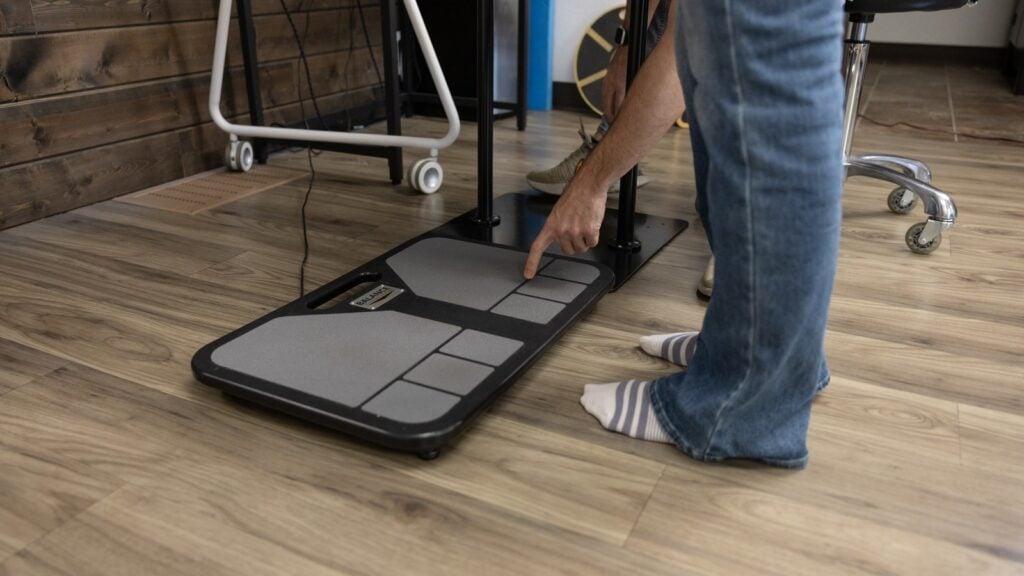
At Brain Restore Centers, the MoCA is one of seven parts of a brain function assessment. It sits alongside a detailed history, a symptom index, a bedside neurological exam, a qEEG brain map, computerized balance testing and lab markers.
Each piece checks the others. For example, a person who reports word-finding problems on the symptom index and also loses points on the MoCA’s language section gives the team a consistent signal. If the MoCA is within range but balance testing or the qEEG shows a notable pattern, the team knows to look further rather than stopping at a “normal” screen.
The MoCA is also useful for tracking change. Because it is standardized, it can be repeated during re-assessment to see whether specific skills have changed. Alternate versions exist to reduce the chance of remembering answers from one test to the next.
Can you prepare for the MoCA?
You do not need to study, and practicing the test can make results less accurate. What helps is giving yourself a fair chance to perform as you normally would:
- Sleep as well as you can the night before.
- Bring your glasses and hearing aids if you use them.
- Eat and take regular medications as usual unless told otherwise.
- Tell the examiner if you are unwell, in pain, very anxious, or more comfortable in another language.
When to ask about cognitive screening
Consider asking about an assessment if you or someone close to you notices changes such as repeating questions, missing appointments or bills, getting lost in familiar places, struggling to follow conversations, or finding work tasks unusually hard. Memory and thinking changes can have many causes, and some are very manageable once identified.
Sudden confusion, trouble speaking, weakness on one side or a severe headache are different. Those need emergency care right away.
The bottom line
The MoCA is a quick, well-researched screening test that can pick up subtle changes in thinking. Its score is most helpful when it is interpreted in context and combined with other measures. At Brain Restore Centers, our mission is to give people a clear, measurable starting point for their brain health, so that changes can be understood, tracked and acted on rather than simply watched.
This article is for general education, not individualized medical advice. Discuss persistent or worsening symptoms with a qualified healthcare professional.