Persistent mental fatigue is not proof that you lack discipline. Sleep problems, medicines, mood symptoms, illness and other factors can make ordinary tasks feel disproportionately demanding. The appropriate response is to investigate what is contributing and adapt the plan to your capacity—not assume that everyone needs to push harder.
In Episode 4 of Restoring Brain Health, the hosts describe a familiar loop: you feel exhausted, do less, find meals and routines harder to manage, then feel discouraged about doing less. Their discussion of brain energy helps explain why motivation alone is an incomplete answer.
But “low energy” is a symptom description, not a specific diagnosis. Understanding the biology can be useful while still leaving room for a proper medical assessment.
First, describe what “tired” means for you
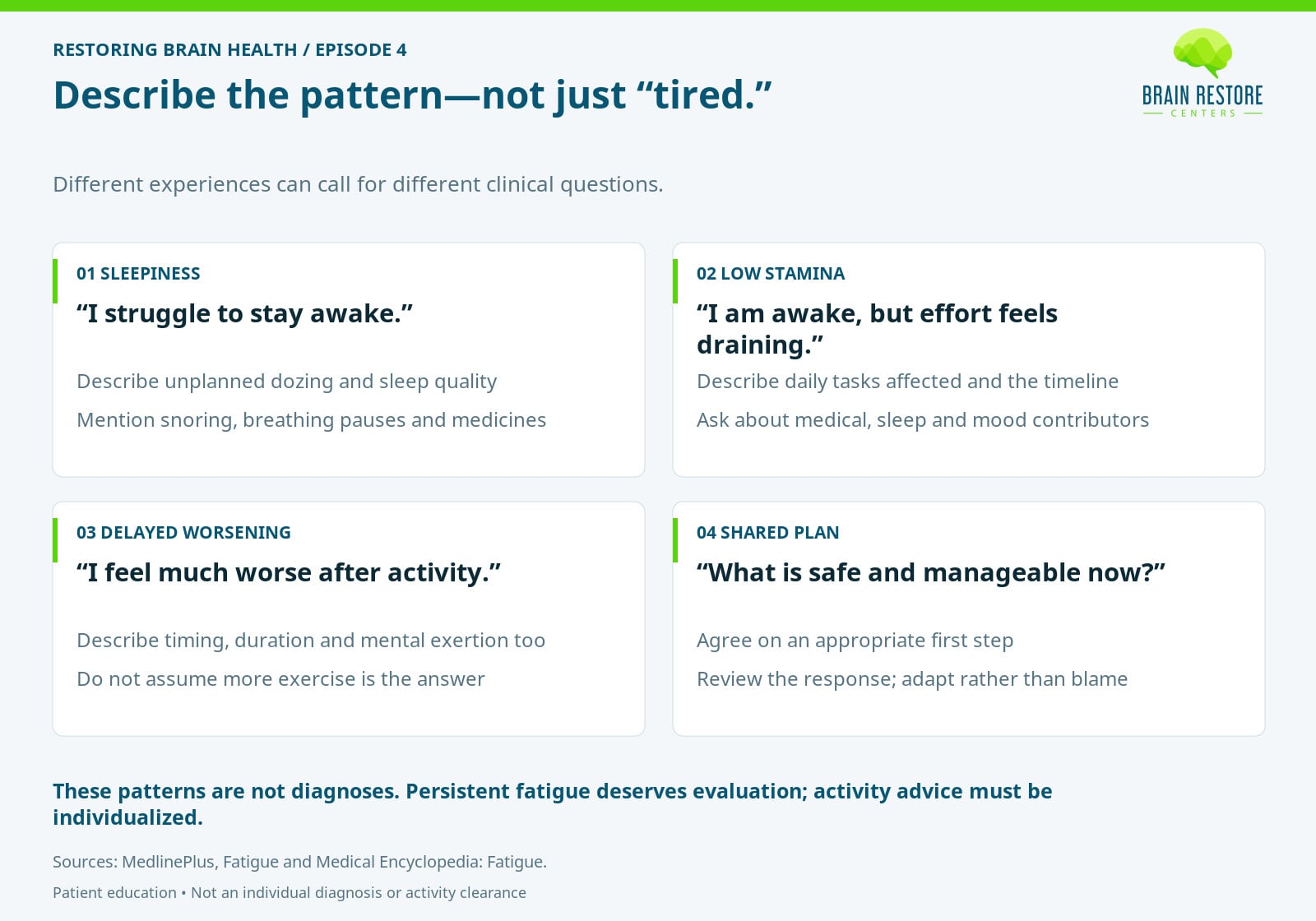
Fatigue, sleepiness and difficulty initiating a task can feel similar, but the differences matter. Sleepiness means a tendency to fall asleep. Fatigue is a sense of depleted energy or exhaustion. Some people also experience low motivation or a loss of interest in activities.
MedlinePlus distinguishes these experiences and describes many possible causes of fatigue, including anemia, thyroid conditions, medicines, pain, depression and sleep disorders. No short list can determine which explanation applies to you.
Try describing a concrete example. “I fall asleep while reading” conveys something different from “I stay awake but cannot sustain a conversation.” “I can manage the task, but I feel markedly worse the next day” is another important pattern. Tell your clinician about those differences rather than using only the word tired.
Also note the onset. A gradual change over months, a sudden change after an illness and a change after starting a medicine may lead to different questions. If fatigue is persistent, worsening or affecting daily functioning, arrange an evaluation rather than repeatedly resetting your habit tracker.
What mitochondria do—and what symptoms cannot tell you
Mitochondria help cells produce ATP, which powers many cellular activities. Brain signaling and maintenance require energy, so it is reasonable that researchers study energy metabolism in neurological and psychiatric conditions.
The National Institute of Neurological Disorders and Stroke describes mitochondria as cellular energy factories when explaining mitochondrial disorders. Those disorders are specific medical diagnoses. They are not the same as feeling depleted during a difficult week or having persistent brain fog.
The episode’s “energy failure” language is best understood as a framework for discussion, not evidence that your cells are failing. Neither your fatigue score nor a qEEG brain map directly tells you your brain’s ATP level. A plausible biological story does not identify the cause in an individual.
The useful next question is what is limiting your capacity and what might help in your situation. A clinician can connect your symptom history with an appropriate assessment, then discuss options supported by evidence relevant to your needs.
Why “just exercise” can be unhelpful advice
Movement can support health, but advice needs to match the person receiving it. Someone with dizziness, chest symptoms, severe fatigue or a recent head injury needs different guidance from an otherwise healthy person returning to activity after a sedentary spell.
It is also important to describe delayed worsening after activity. Some conditions, including ME/CFS, can involve symptoms becoming worse after physical or mental exertion. MedlinePlus’s fatigue overview explains that this is not ordinary tiredness relieved by rest. If you experience a substantial or delayed “crash,” do not assume increasing exercise is the right response; discuss that pattern with a clinician.
For concussion, recommendations are condition-specific too. The Amsterdam sport-concussion consensus supports relative rather than prolonged strict rest, followed by activity tailored to symptoms and clinical guidance. It is not a blanket instruction to perform vigorous exercise while feeling unwell.
Good advice preserves the purpose—supporting health—while changing the dose, timing or activity when needed. It should not frame an inability to follow a generic routine as a moral failure.
What a well-known exercise study actually found
In a 2011 randomized trial by Erickson and colleagues, 120 older adults without dementia took part in a year-long program. Researchers compared aerobic exercise with stretching and toning. They reported an average increase of about 2% in anterior hippocampal volume in the aerobic group.
The NIH’s summary of the study explains an important detail: both groups improved on spatial memory tests. In the walking group, increases in hippocampal size were associated with better memory performance. That is more nuanced than saying that exercise simply “grew the brain and fixed memory.”
This trial supports interest in physical activity and brain health. It does not establish that a person with unexplained fatigue should follow the same schedule, that walking cures cognitive symptoms or that a visible brain-volume change predicts a benefit for everyone.
Study population and duration matter. A year-long supervised research program in older adults without dementia is not interchangeable with advice for someone recovering from a head injury or living with a fatigue-related illness.
Build a plan that starts where you are
Start by reducing the number of simultaneous decisions. Instead of “fix my sleep, food, exercise and stress,” choose one task that makes the next appointment or next day easier. That might mean collecting your medicine bottles, arranging a primary-care visit or asking someone to help with meal preparation.
For activity, ask what is safe for your current situation. If your clinician agrees that gentle movement is appropriate, discuss a manageable starting point and how to judge your response. The right starting point may be substantially smaller than a generic public-health target.
For food, focus on a feasible pattern rather than an elaborate reset. A prepared option, help with shopping or a simple repeatable meal may be more useful than a plan requiring extensive cooking. Medical conditions and dietary restrictions should guide any specific changes.
For sleep, describe the problem rather than assuming you need stronger willpower at bedtime. Snoring, breathing pauses, repeated awakenings and daytime sleepiness may warrant evaluation. Ask whether pain, work schedules or medicines could be contributing.
Use a short record, not a second job
A brief record can help clarify patterns. Note the task, approximate effort, symptoms during it and how you felt later that day or the next day. Include sleep and any major change in medicines or illness.
You do not need an exhaustive diary or a wearable device to make the appointment worthwhile. A few representative examples can show why a routine that looks simple on paper is not working in real life.
The purpose is to improve the conversation, not prove that you are trying hard enough. Stop tracking if it becomes an additional burden or increases distress, and ask your clinician what information would actually help.
What to ask before accepting an energy-focused explanation
Ask what alternative causes have been considered and whether any tests are appropriate. Ask whether the proposed assessment directly measures the thing being discussed or provides only indirect information.
If an intervention is suggested, ask about human studies, the outcomes measured, possible harms, costs and what would count as lack of benefit. Research about mitochondria does not automatically validate every product marketed with mitochondrial language.
Finally, agree on a follow-up plan. Persistent fatigue deserves attention, and a plan should change when new information appears. Seek urgent help for sudden neurological changes, severe new symptoms or immediate safety concerns. Do not drive if you are too sleepy to do so safely.
The useful takeaway from Episode 4 is compassionate and practical: capacity matters. Finding one tolerable next step, alongside an appropriate assessment, is more constructive than blaming yourself for not being able to do everything at once.
This article is for general education, not individualized medical advice. Discuss persistent or worsening symptoms with a qualified healthcare professional.