
Brain fog, forgetfulness and mental exhaustion can overlap, but they do not point to one diagnosis. Inflammation and the brain’s energy needs offer useful ways to discuss symptoms. They cannot, by themselves, tell you what is causing your symptoms or which care will help. A careful history, medical evaluation and appropriate follow-up still come first.
That distinction is the starting point for Episode 4 of Restoring Brain Health. Dr. Chad Woolner, Dr. Trevor Berry and Dr. Sharon Webb explore why seemingly different complaints can share biological pathways. Their conversation also recognizes a frustrating experience: knowing that sleep, movement and nutrition matter while feeling too depleted to change anything.
This guide takes the episode’s two frameworks further, separating established biology from clinical conclusions. The goal is not to give you another label to worry about. It is to help you arrive at your next appointment with clearer questions and a manageable next step.
Watch or listen to Episode 4
Watch the full episode: Episode 4 on YouTube.
Listen on Spotify · Listen on Apple Podcasts · Subscribe on YouTube
The Spotify and Apple links open the show, not an individual episode. Listen directly to Episode 4 audio.
Why one person can have several different symptoms
Remembering an appointment requires more than a memory “storage” system. You have to notice the information, sustain attention, encode it and retrieve it later. Poor sleep, pain, stress or medication effects can interfere with parts of that process. The experience may feel like memory loss even when the immediate difficulty begins with attention.
Similarly, fatigue can change how much effort a normal task requires. Someone who manages a conversation well in a quiet room may struggle in a noisy workplace. Symptoms that vary with demand are still worth discussing; variation does not mean they are imaginary.
The National Institute on Aging’s guide to cognitive health highlights physical health, medicines, sleep and other contributors. A clinician may review those factors alongside a neurological examination, cognitive testing or other investigations when indicated. Not everyone needs the same tests, and no single test answers every question.
Inflammation: a normal response that can become complicated
Inflammation is part of the body’s response to injury and other threats. Within the brain, immune cells called microglia participate in maintenance, responses to injury and communication with other cells. They are not simply harmful cells waiting to be switched off.
A 2017 review of microglial biology describes both protective functions and involvement in neurodegenerative processes. It also emphasizes how complex it is to target these cells therapeutically. This is a review of mechanisms, not a trial showing that a clinic program improves a person’s symptoms.
The episode uses a fire metaphor to explain persistent inflammation. That can make a complicated idea memorable, but a metaphor is not a measurement. Brain fog does not establish that your brain is inflamed. Nor does an elevated blood inflammatory marker, on its own, identify the cause of cognitive symptoms or prove inflammation inside the brain.
The practical question is more specific: are there identifiable health problems that deserve attention? A clinician might consider a recent infection, an inflammatory condition, metabolic health, sleep or another contributor based on your history. It is more useful to investigate a plausible cause than to assume that every symptom reflects the same “fire.”
Brain energy: useful biology, not a fatigue diagnosis
Brain cells need energy to maintain electrical signaling, move substances across cell membranes and carry out maintenance. Mitochondria help produce ATP, a molecule cells use to power many of those activities. That does not mean ordinary tiredness can be diagnosed as mitochondrial failure.
The National Institute of Neurological Disorders and Stroke explains the role of mitochondria in energy production in the context of mitochondrial disorders. Those are specific medical conditions. They should not be confused with the episode’s broader use of “energy failure” as an explanatory framework.
Persistent fatigue has many potential causes. MedlinePlus includes sleep disorders, anemia, thyroid disease, medicines, depression and other medical conditions. Some people have more than one contributor. A person can feel exhausted without having a primary mitochondrial disorder, and symptoms alone cannot tell you their ATP level.
This is why compassion and investigation belong together. “Try harder” is not an adequate response to disabling fatigue. Neither is assuming that one energy-focused intervention will solve it for everyone.
Compare the questions—not just the labels
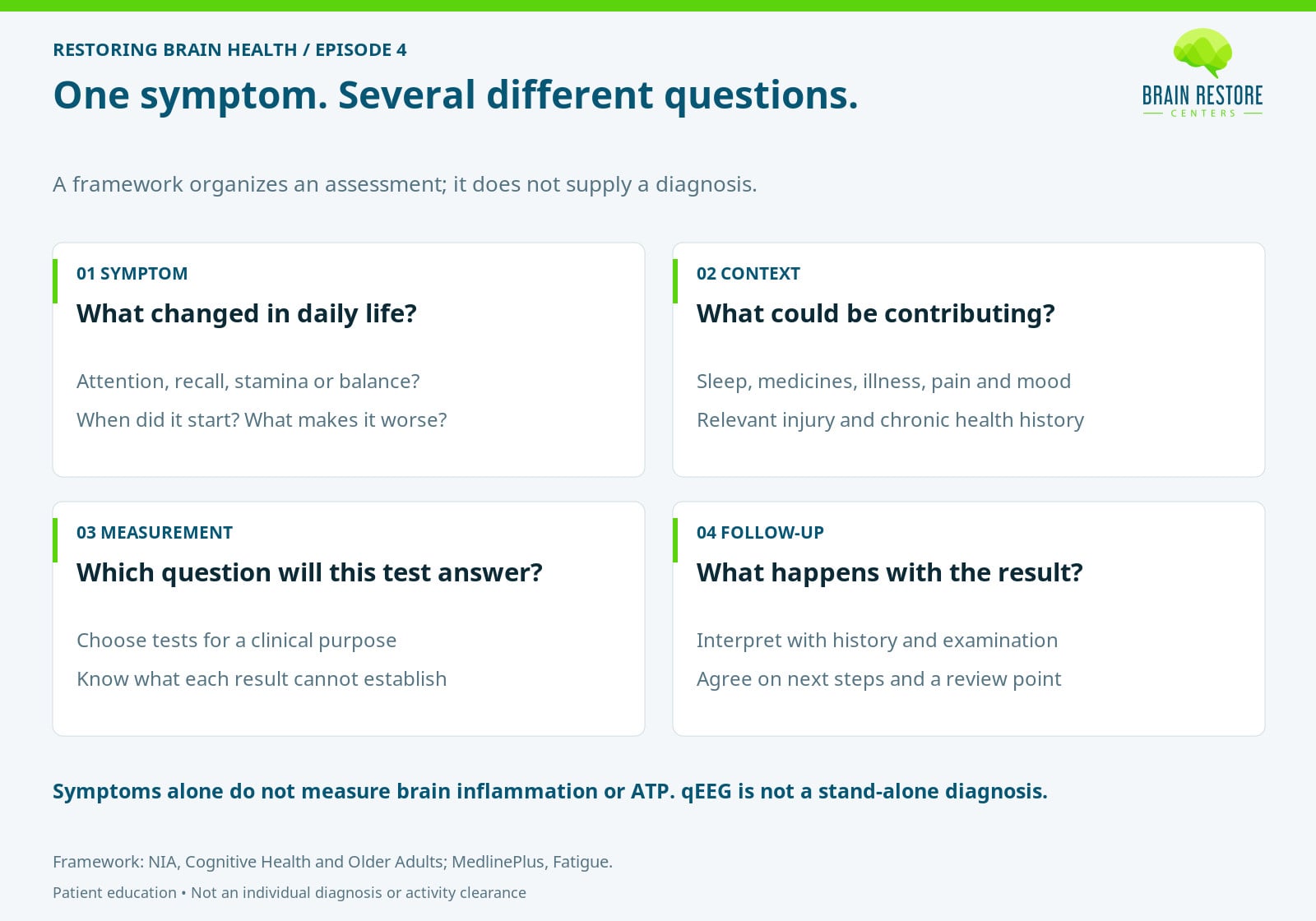
The frameworks discussed in the episode are useful when they help organize questions. They become misleading when they are treated as diagnoses or used to select care without an assessment.
| Framework or tool | Useful question | What it cannot establish by itself |
|---|---|---|
| Inflammation framework | Could injury, illness or an inflammatory condition be relevant to this history? | That brain fog proves neuroinflammation, or that one anti-inflammatory approach will resolve it. |
| Brain-energy framework | Could sleep, nutrition, illness or task demands help explain limited stamina? | A diagnosis of mitochondrial disease or a measured ATP shortage from symptoms alone. |
| Cognitive and neurological evaluation | Which abilities or examination findings have changed, and what warrants further testing? | A guaranteed explanation from one brief result without clinical context. |
| qEEG brain mapping, when appropriate | What patterns appear in recorded electrical activity under the testing conditions? | The cause of every symptom, direct measurement of inflammation or ATP, or a stand-alone dementia diagnosis. |
At BRC, “network interference” is an explanatory phrase for difficulties in how brain networks function or coordinate. It is not a stand-alone medical diagnosis and should not replace the investigation of symptoms. A functional assessment does not replace medically indicated MRI or CT imaging; those tests answer different questions.
What the evidence supports about everyday health
There is a substantial reason to discuss blood pressure, diabetes, hearing, vision, movement and social connection in a brain-health appointment. The 2024 Lancet Commission on dementia synthesizes evidence on 14 potentially modifiable risk factors across life.
Its population model estimates that addressing these factors could prevent or delay a substantial proportion of dementia cases. That is not a prediction for one individual, proof that dementia is anyone’s fault, or evidence that a particular commercial program prevents it. Social circumstances and access to care affect people’s opportunities to change risk.
Exercise research also needs careful translation. In Erickson and colleagues’ randomized trial, 120 older adults without dementia were assigned to aerobic exercise or stretching and toning over a year. The aerobic group showed an average increase in anterior hippocampal volume. This supports interest in physical activity and brain health; it does not show that walking cures memory problems or that the same result occurs after concussion.
Evidence can give you a reason to act without providing a guarantee. Choosing a realistic activity, treating a diagnosed condition and reviewing a medication concern are meaningful steps even when the outcome cannot be promised.
A five-step plan for your next appointment
First, describe the change in daily-life terms. “I lose track halfway through a work email” is more useful than “my brain is broken.” Note when it began, whether it is worsening and whether someone close to you has noticed a change.
Second, bring your medicines and supplements list, including nonprescription sleep aids and allergy products. Ask whether anything could be affecting alertness or thinking. Do not stop prescribed medicines on your own.
Third, discuss sleep and stamina. Mention snoring, pauses in breathing, unrefreshing sleep, daytime sleepiness and whether physical or mental effort makes you substantially worse later. These details can change the advice that is appropriate for you.
Fourth, ask what needs evaluation now and what will be monitored. If a test is recommended, ask what question it answers, its limitations and how its result would change the plan.
Finally, agree on one achievable next step and a follow-up date. That might be arranging a medical review, recording symptoms briefly or planning an activity within your current capacity. You do not have to solve every health habit in the same week.
When not to wait
Sudden confusion, new weakness, trouble speaking or a sudden severe headache need emergency evaluation, not a routine brain-health appointment. After a head injury, the CDC lists danger signs including a worsening headache, repeated vomiting, seizures, unusual behavior and difficulty waking. Call 911 or seek emergency care for these signs.
For ongoing symptoms without an emergency, ask for an evaluation rather than assuming the explanation is simply age, stress or lack of motivation. Episode 4’s most useful message is that the whole person matters. Its frameworks should open a conversation—not close off other explanations.
This article is for general education, not individualized medical advice. Discuss persistent or worsening symptoms with a qualified healthcare professional.