
Inflammatory processes can affect brain function in some illnesses and injuries, but brain fog alone does not prove inflammation in the brain. The same complaint can arise with poor sleep, medication effects, mood symptoms and many medical conditions. Finding the cause requires a history and an appropriate clinical assessment, not a symptom checklist that assigns everyone the same explanation.
Episode 4 of Restoring Brain Health discusses inflammation as one possible common pathway behind different brain-health problems. That is a useful starting point if you are trying to understand why concentration, memory and energy can change together. It is not a reason to self-diagnose “an inflamed brain” or buy a test or supplement before asking what problem is actually being investigated.
Here is how to use the idea without letting it become an answer to everything.
What does inflammation do in the brain?
Inflammation involves coordinated responses by immune cells and chemical signals. In the central nervous system, microglia help maintain the local environment and respond to injury. Their roles include clearing cellular debris and interacting with other cells.
A review in Annual Review of Immunology describes microglia in normal brain function as well as disease. It is important that both sides remain in the explanation. Immune activity is not automatically a malfunction, and “turning off inflammation” is not a precise description of what a healthy brain needs.
The timing, location and nature of a response matter. A short-term response to an injury is not the same situation as a persistent, dysregulated process in a chronic illness. Even within a diagnostic category, people can differ substantially.
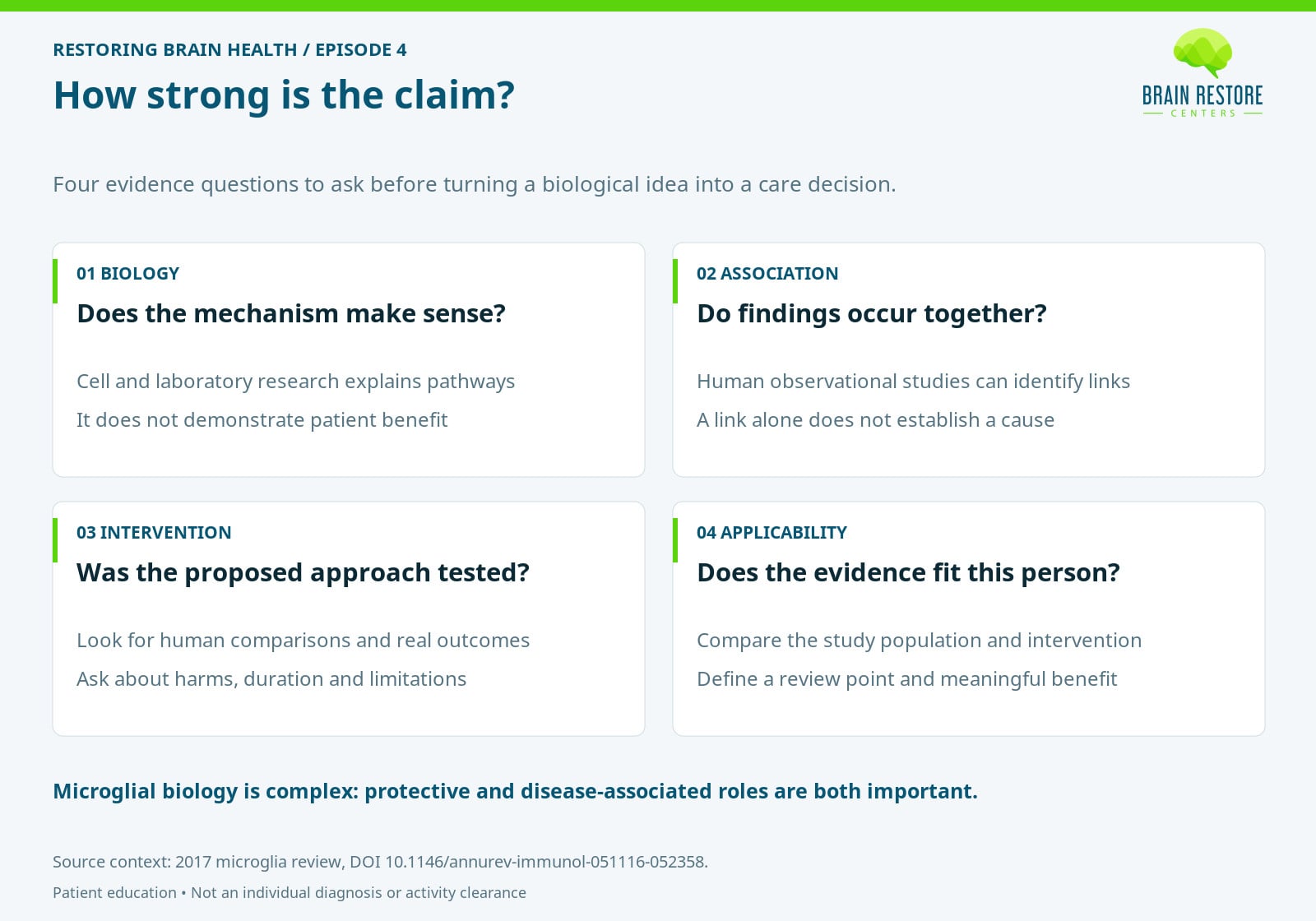
The review is biological evidence about cells and mechanisms. Much mechanistic work does not directly tell us which intervention improves daily functioning in a particular patient. A plausible mechanism needs clinical evidence before it becomes a reliable treatment recommendation.
Why symptoms cannot identify the mechanism
“Brain fog” is a description people use for experiences such as slowed thinking, losing a train of thought or difficulty concentrating. It is not one disease. Two people can use the same phrase while having different causes and different needs.
For example, someone who sleeps poorly may have trouble attending to a conversation. Another person may notice cognitive changes after an illness. Someone else may have started a medicine that affects alertness. These possibilities can overlap, which is why the timeline is often more useful than the label.
The National Institute on Aging’s cognitive-health guidance recommends attention to chronic health conditions, medicines, sleep and other aspects of physical health. That broad assessment is not a dismissal of brain symptoms. It recognizes that the brain operates within a body and a daily environment.
A clinician will also consider whether there are neurological changes or loss of everyday abilities that need more specific investigation. Repeatedly missing important payments, getting lost on a familiar route or a change that others notice deserves discussion, rather than an assumption that inflammation explains it.
Can a blood test or brain map show the cause?
Some blood tests measure markers associated with inflammation in the body. A result can be useful when ordered for a specific clinical question. It does not, by itself, establish that inflammation inside the brain is responsible for fogginess or memory changes.
Similarly, a qEEG brain map analyzes patterns in recorded electrical activity. It does not directly measure microglial activity, brain inflammation or the body’s ATP supply. A result needs interpretation alongside the recording conditions, symptoms, history and other findings.
Before agreeing to any assessment, ask three questions: What exactly does this measure? What conclusions are supported by that measurement? What would change in my care if the result were different? Clear answers help distinguish a useful investigation from a test being asked to explain more than it can.
There may not be one definitive test for your complaint. A staged assessment can be reasonable when it has a clear purpose and follow-up plan. “We do not know yet” is more honest—and often more useful—than a confident explanation unsupported by the available information.
Where vascular and metabolic health fit
The episode connects brain health with high blood pressure, diabetes and cholesterol. These deserve attention for established medical reasons, not because every person with one of these conditions must have an inflamed brain.
The 2024 Lancet Commission on dementia prevention, intervention and care reviews evidence on potentially modifiable risks across life. Its framework includes hypertension, diabetes, physical inactivity and high LDL cholesterol, among other factors. It also includes hearing and vision loss, social isolation and air pollution—reminders that brain health is not just about food choices or personal discipline.
The report combines different kinds of evidence and estimates population-level prevention potential. It does not show that changing one risk factor will resolve an individual’s brain fog or prevent their dementia. An association with future risk is different from identifying the cause of symptoms today.
Ask your own clinician what blood pressure or cholesterol targets are appropriate for you. A number mentioned in a podcast is not a universal target. Your medical history, medicines, age and overall risk can change the recommendation.
Does an “anti-inflammatory diet” answer the question?
Food choices are worth discussing, but the phrase “anti-inflammatory diet” can make eating sound more specific and medically powerful than the evidence allows. A meal pattern is not a diagnostic test, and no food can confirm that inflammation caused a symptom.
The NIA’s cognitive-health guidance supports attention to healthy eating while noting that evidence is not definitive that a particular diet prevents cognitive decline. A workable conversation can start with access, appetite, regular meals and a varied eating pattern rather than a restrictive plan.
Do not assume an omega-6-to-omega-3 ratio, a food-sensitivity panel or a supplement recommendation is a validated explanation for cognitive symptoms. Ask what evidence supports the particular test, what its result would change and whether the recommendation carries risks or interacts with medicines.
If preparing meals feels overwhelming, describe that barrier. A clinician or dietitian can help adapt advice to your medical needs, resources and capacity. A plan that ignores disability, budget or caregiving demands is unlikely to be useful.
Five questions to bring to a visit
Start with the timeline: “Could the onset after an illness, injury or medicine change help narrow the possibilities?” Bring dates or a short sequence of events rather than trying to reconstruct everything during the appointment.
Ask about alternatives: “What common or important causes should we consider besides inflammation?” This invites a broader assessment without arguing that inflammation is irrelevant.
Ask about testing: “If you recommend a marker or brain assessment, what would a normal or abnormal result mean?” Include the test’s limitations in that conversation.
Ask about the proposed plan: “Is this advice based on human outcome studies, a biological theory or clinical experience?” Each can inform care, but they should not be presented as interchangeable evidence.
Finally, ask about follow-up: “What change should we watch for, and when should I come back if I am not improving?” A defined review point is more actionable than an open-ended promise to reduce inflammation.
Keep the useful idea—and its limits
Inflammation research helps explain why injury, immune activity and brain function can intersect. The next step is to connect that knowledge with your own history, rather than assume every symptom comes from the same process.
For persistent or worsening symptoms, arrange medical evaluation. Sudden confusion, weakness or trouble speaking needs emergency care. If symptoms followed a head injury, review the CDC’s danger signs and seek emergency help when they occur.
The best use of the episode’s framework is a better question: “What is relevant in my case, and how will we know?” That keeps the conversation grounded in your life rather than a label.
This article is for general education, not individualized medical advice. Discuss persistent or worsening symptoms with a qualified healthcare professional.