
The short answer
Usually, it means nothing dangerous or surgical was found, so there’s no reason to act right now. It can mean trying conservative care first, re-checking a small finding that is unrelated to your symptoms, waiting for clearer evidence before starting strong medication, or that every test was clear even though you still have symptoms. It’s a pause on the structural question, not a statement that nothing else can be done.
On Episode 2 of Restoring Brain Health, neurosurgeon Dr. Sharon Webb walked through what doctors usually mean when they say it. Knowing which situation you’re in tells you what has been answered, and what hasn’t. Here are the four most common, with what the research says about each.
1. “Let’s try conservative care first”
Dr. Webb’s example: someone has back and leg pain, and an MRI shows a minor disc bulge. Is that bulge actually causing the pain? Maybe, maybe not. Rather than jumping to surgery, doctors often try physical therapy or other conservative options first. “That is a reasonable approach,” she says.
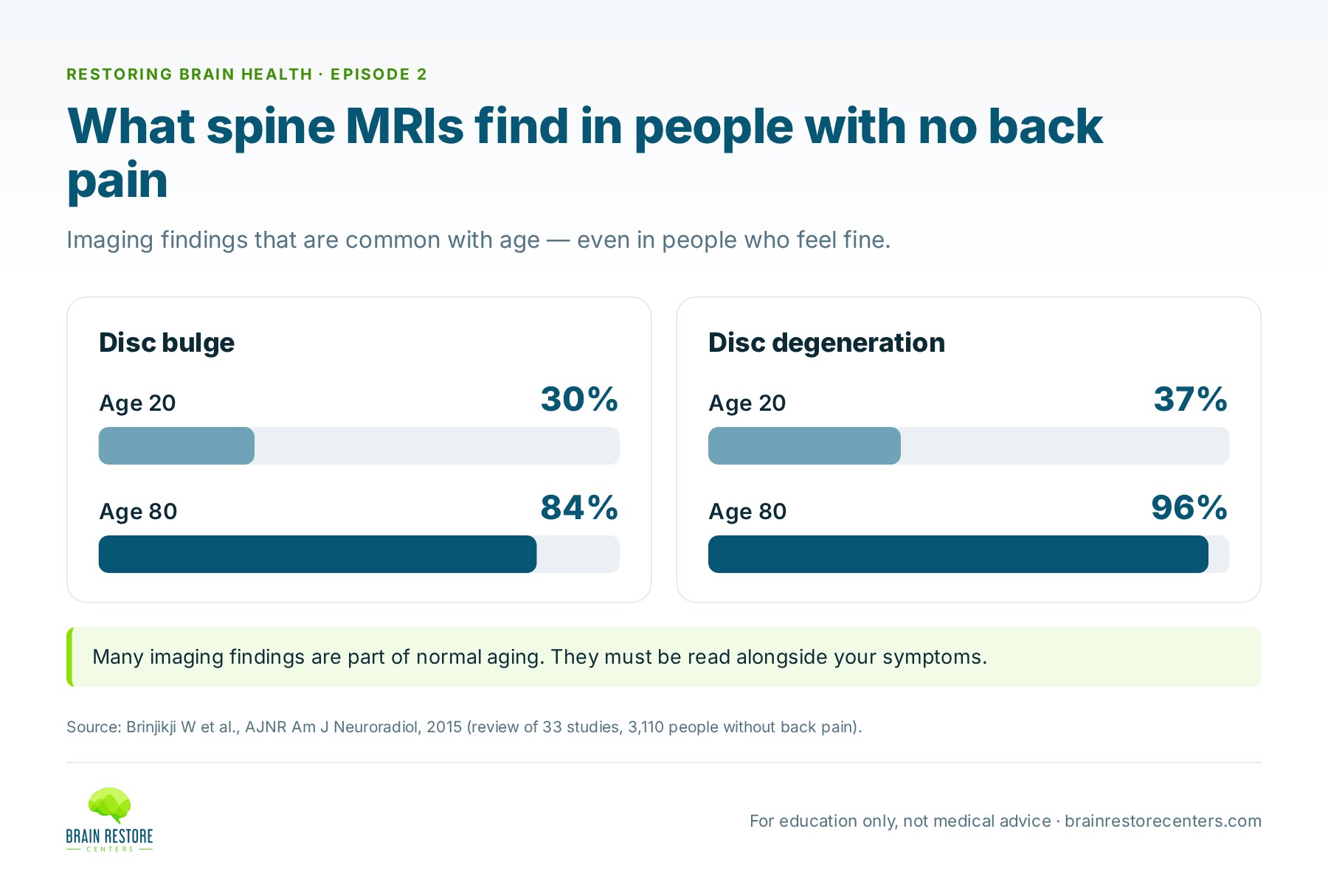
Research backs up her caution about reading too much into an image. A review of 33 studies covering more than 3,000 people with no back pain at all found disc bulges in 30% of 20-year-olds and 84% of 80-year-olds. Disc degeneration showed up in 37% of 20-year-olds and 96% of 80-year-olds. The authors concluded that many of these findings are part of normal aging and must be read in the context of the person’s symptoms.
Dr. Berry made the same point on the show: an image can look like “a train wreck” while the person feels fine, and another can look perfectly normal while the person is suffering. That’s why a good hands-on neurological exam, checking reflexes, strength and sensation, matters. It helps confirm or rule out what the picture suggests.
2. “We found something small, but it’s not causing your symptoms”
Sometimes imaging picks up an incidental finding: something real that has nothing to do with why you came in. Dr. Webb’s example is a person with weeks of migraine-type headaches whose imaging shows a one-millimeter aneurysm (a tiny bulge in a blood vessel). It’s real, but it isn’t causing the headaches. “There isn’t anything for you to do about that except to watch it,” she says. The plan is to repeat imaging in six months or a year to make sure it isn’t changing.
Incidental findings like this are more common than most people think. When researchers in the Rotterdam Study performed brain MRI on 2,000 adults from the general population (average age 63), they found silent old strokes in 7.2%, aneurysms in 1.8% and benign tumors, mostly meningiomas, in 1.6%. None of these people had symptoms from them.
Why watch rather than act? Size matters. In a Japanese study that followed more than 5,700 people with unruptured aneurysms, 91% of which were found incidentally, the risk of rupture rose sharply with size. Compared with aneurysms 3 to 4 mm across, those 7 to 9 mm were about three times as likely to rupture, and those 10 to 24 mm about nine times as likely. For very small findings, careful monitoring is often the wisest path.
The important thing to understand: in this situation, the waiting is about the incidental finding. Your original symptoms, the headaches in Dr. Webb’s example, still need an explanation.
3. “We don’t have enough evidence to start strong medication”
Sometimes symptoms hint at a condition, but the tests can’t confirm it yet. Dr. Webb’s example is multiple sclerosis (MS). Someone has an episode of optic neuritis, or numbness and tingling, that resolves on its own, and their MRI shows no changes. MS medications can be strong and come with side effects. “You’re not going to throw them on there without proof,” she says. So the plan is to re-check in three or six months.
Dr. Webb went further. In that situation, she says, it would not be unreasonable for a patient to think:
“I want to see if there’s something else that shows up on a microscopic level, because on a macroscopic level, we haven’t found anything yet.”
— Dr. Sharon Webb, describing a patient’s reasonable next step, on Restoring Brain Health, Episode 2
This is the heart of the episode: the waiting period for a medication decision can also be a window for functional testing.
4. “Everything is clear, but you still don’t feel right”
After a fall, a car accident or a concussion, imaging is often negative, yet symptoms continue. Nothing needs surgery, and there’s nothing structural to follow. “So something is wrong,” Dr. Webb says. “Your exam is not normal, your history is not normal.”
This group is much larger than most people realize. In the TRACK-TBI study, 991 people with a mild brain injury had a normal head CT. Of those followed up at two weeks, 73% had not fully recovered. At six months, 56% still had not. The researchers recommended routine two-week follow-up visits so these patients aren’t missed.
Dr. Berry shared a story from his clinic that captures this group: a young patient who had been to top neurology centers for dizziness and lightheadedness. One center was excited to report that he didn’t have a tumor. Great news. But as Dr. Berry noted, it didn’t answer why he was still suffering.
What “watch and wait” doesn’t say out loud
“Okay, my role here is done for now.”
— Dr. Chad Woolner, describing what a good doctor means, on Restoring Brain Health, Episode 2
In each of these four situations, the structural question has been addressed for now. What usually hasn’t been addressed is function: how well your brain’s networks are actually working together. When testing shows they aren’t working together as well as they should, at Brain Restore Centers we call it network interference. It’s something we measure, not a diagnosis.
Questions to ask your doctor before you leave
- Which of these situations am I in: conservative care, an incidental finding, not enough evidence yet, or all clear?
- What exactly did my tests rule out?
- When is my next check, and what will it look at?
- Which symptoms mean I should come back sooner instead of waiting?
- Is there anything I can do in the meantime?
When does the waiting stop?
Doctors usually explain what would bring you back in sooner. Dr. Webb’s example is a thunderclap headache, a sudden, severe headache. “Then that’s a change in what’s going on,” she says. Anything sudden or new means no more watching and waiting. Call 911 for sudden severe symptoms.
Next: 6 proactive steps to take while you watch and wait, or read the full guide: Told to “watch and wait”? What it means and what you can do in the meantime.
Studies referenced
- Brinjikji W, et al. Systematic literature review of imaging features of spinal degeneration in asymptomatic populations. AJNR Am J Neuroradiol. 2015;36(4):811–816. https://pubmed.ncbi.nlm.nih.gov/25430861/
- Vernooij MW, et al. Incidental findings on brain MRI in the general population. N Engl J Med. 2007;357(18):1821–1828. https://pubmed.ncbi.nlm.nih.gov/17978290/
- UCAS Japan Investigators. The natural course of unruptured cerebral aneurysms in a Japanese cohort. N Engl J Med. 2012;366(26):2474–2482. https://pubmed.ncbi.nlm.nih.gov/22738097/
- Madhok DY, et al.; TRACK-TBI Investigators. Outcomes in patients with mild traumatic brain injury without acute intracranial traumatic injury. JAMA Netw Open. 2022;5(8):e2223245. https://pubmed.ncbi.nlm.nih.gov/35976650/
Watch the full conversation: Restoring Brain Health, Episode 2.
Find out how your brain is working right now
The first step is a Complimentary Brain Scan at a Brain Restore Center near you: a functional look at how your brain is working today. No pressure, no assumptions. If it looks like we may be able to help, we’ll talk about next best steps.
This article is for education and is not medical advice. It does not replace care from your own doctor. If you have sudden or severe symptoms, such as a sudden severe headache, new weakness or numbness, trouble speaking, or confusion, call 911 or go to the nearest emergency room.