The short answer
Keep your follow-up appointment, and add information in the meantime. Know which symptoms mean you should go back sooner, track how you feel, get a functional baseline of how your brain is working, look at the everyday factors research links to brain health, and re-measure later. The brain can change at any age, so the waiting period is a window, not dead time.
“Watching and waiting isn’t a plan in and of itself,” Dr. Chad Woolner says on Episode 2 of Restoring Brain Health. This post turns the waiting period into one. First, the science that explains why it’s worth doing.
Why acting early matters: what neuroplasticity research shows
Dr. Trevor Berry calls it a theme you’ll hear in every episode: “You’re not stuck with the brain that you have.” Neuroplasticity means the brain can rewire and strengthen its connections in response to what it does and the environment it’s in. That idea was once controversial, and the hosts noted on the show that it took a long fight to win acceptance. Here is some of the research behind it.
The adult brain makes new neurons
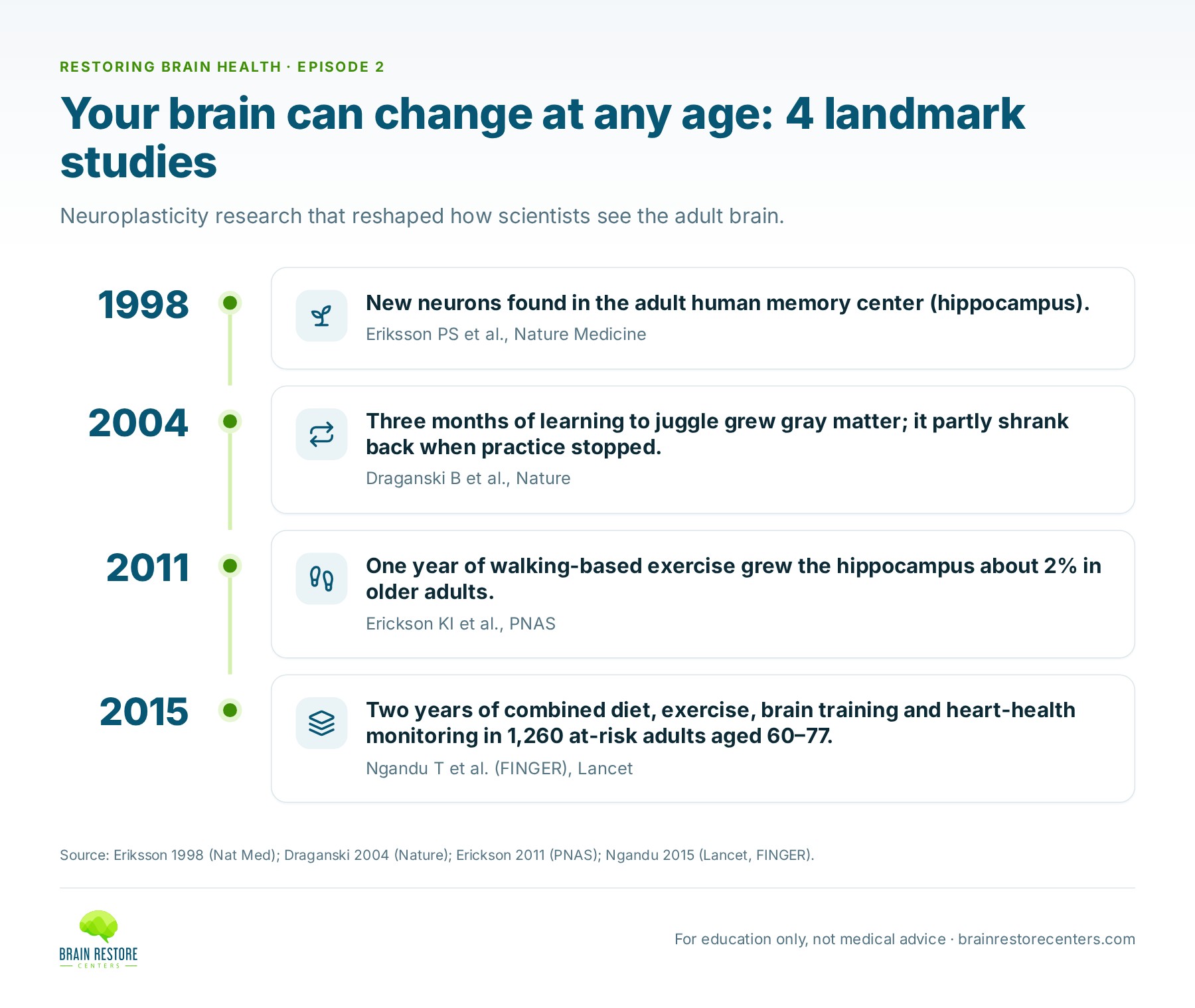
In 1998, researchers in Sweden and the U.S. showed for the first time that new neurons are formed in the adult human hippocampus, a region central to learning and memory. Their conclusion: the human hippocampus “retains its ability to generate neurons throughout life.”
Learning a new skill changes brain structure
In a 2004 study in Nature, adults who spent three months learning to juggle showed measurable growth in gray matter in areas that process visual motion. When they stopped practicing, those areas shrank back somewhat. Use it and it grows; stop and it fades.
Exercise can grow the memory center
In a randomized trial of 120 older adults, one year of moderate aerobic exercise (mostly walking) increased the size of the hippocampus by about 2% and improved spatial memory. The control group’s hippocampus kept shrinking. The authors described the effect as reversing one to two years of age-related loss.
Dr. Berry’s summary: “As long as you’re living and breathing, you can make change.” He’s also honest that change can get harder over time. Put those together and you get the core message of the episode: timing is key.
Step 1: Keep your follow-up appointment
This isn’t either-or. “Keep that appointment,” Dr. Woolner says. Your follow-up keeps an important structural check in place. Everything else on this list happens alongside it, not instead of it.
Step 2: Know what would send you back sooner
Ask your doctor which changes mean you shouldn’t wait, and write them down. Neurosurgeon Dr. Sharon Webb says anything sudden or different, like a thunderclap headache, ends the waiting. Common warning signs include a sudden severe headache, new weakness or numbness, trouble speaking, new confusion, or a seizure. These call for 911, not a follow-up visit.
Step 3: Track your symptoms like data
Memory for symptoms is unreliable, especially when the brain is the thing struggling. A simple daily log fixes that. Rate each from 0 to 10 and note what was going on:
- Headache, dizziness or light sensitivity
- Brain fog, focus and word-finding
- Sleep: hours, quality, waking up at night
- Mood, irritability and anxiety
- Balance and coordination
- What you did that day: screen time, exercise, stress, alcohol
For a parent watching a child after a concussion, or an adult child watching a parent’s memory, note specific examples with dates. “Asked the same question three times at dinner on Tuesday” is far more useful to a clinician than “seems forgetful.”
Step 4: Get a functional baseline
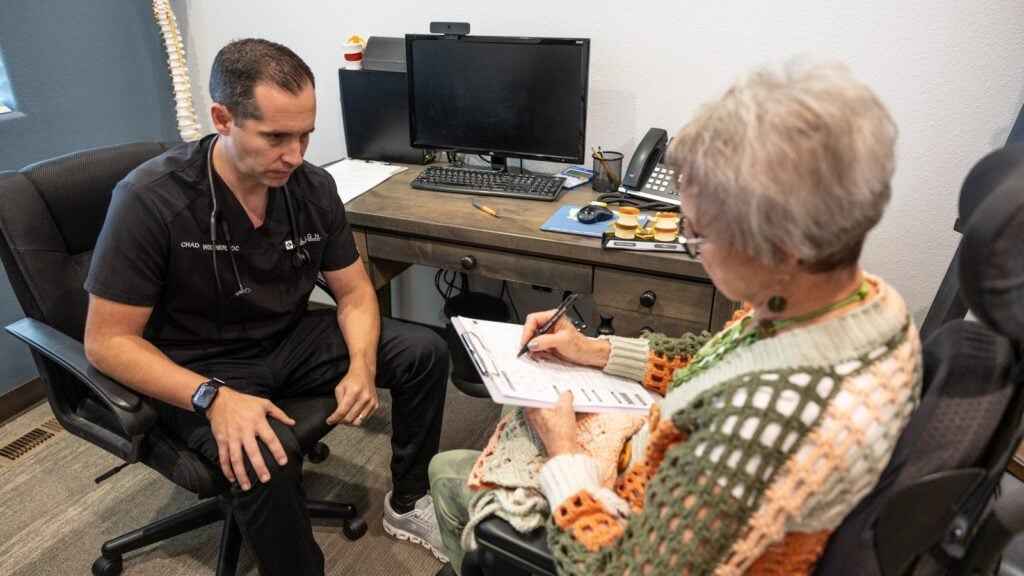
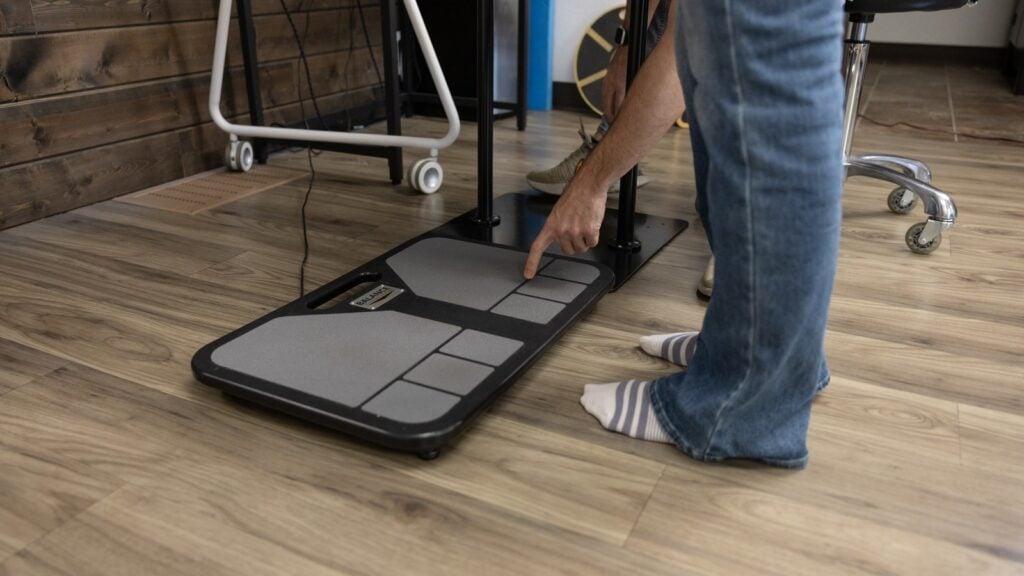
Imaging tells you about structure. A functional baseline tells you how the brain is working right now, and gives you something to compare against later. Dr. Berry recommends looking from several angles: brainwave activity, computerized balance testing, a memory and thinking screen, a hands-on neurological exam and relevant labs. We explain what each test measures and how it works in What a brain health baseline includes.
When testing shows that areas of the brain aren’t working together as well as they should, at Brain Restore Centers we call it network interference. It’s something we measure, not a diagnosis.
Step 5: Look at the everyday factors research links to brain health
No single change is the answer. Brain health has many pillars, and the strongest research supports looking at several together.
- Many factors, one brain. The 2024 Lancet Commission on dementia identified 14 modifiable risk factors across life, including physical inactivity, high blood pressure, diabetes, hearing loss, vision loss, high LDL cholesterol, smoking, social isolation, depression and traumatic brain injury.
- Combined approaches. In the FINGER trial, 1,260 at-risk adults aged 60 to 77 were randomly assigned to two years of combined diet, exercise, brain training and heart-health monitoring, or to general health advice. The combined group did better on a broad set of thinking and memory tests.
- Nutrients matter. Dr. Berry pointed out that labs like B vitamins often get overlooked. In the VITACOG trial, older adults with mild memory problems who took B vitamins (folic acid, B6 and B12) for two years had a slower rate of brain shrinkage on MRI than those on placebo (0.76% vs. 1.08% per year). The effect was largest in people who started with high homocysteine, a blood marker linked to low B vitamins. Talk to your doctor before starting supplements; the point is to test, not guess.
Step 6: Re-measure and adjust
A baseline is most useful when you measure again. Dr. Webb describes it as the core of good medicine:
“You get objective data in the beginning, you reassess.”
— Dr. Sharon Webb, on Restoring Brain Health, Episode 2
Re-measuring shows what has changed, what hasn’t, and whether the plan needs to change. It also gives you something concrete to bring to your next doctor’s appointment.
Brain science is moving fast
Part of the reason there’s more to do now than there was a decade ago is that brain science keeps advancing. Dr. Webb described how stroke care was transformed in her career, as newer clot-retrieval devices replaced older ones. A 2016 analysis of five randomized trials found that removing the clot with a catheter reduced disability at 90 days; for every 2.6 patients who received it, one had less disability. Her takeaway about new technology: “now it’s no longer can we, it’s should we.”
Dr. Berry noted the same growth on the non-surgical side, with thousands of peer-reviewed papers now published on areas like low-level light. A 2016 review from Massachusetts General Hospital summarizes how red and near-infrared light interacts with brain cells and the lab and clinical research across many brain conditions. The bigger point: what we know about brain function and how to measure it keeps growing, which is why staying informed during the waiting period pays off.
A real-world example of why waiting costs ground
Dr. Woolner described a family at the clinic whose daughters noticed odd changes in their mom’s thinking. They took “watch and wait” literally and simply observed. Only when things became hard to ignore did they seek another opinion. “Had they started looking at function the moment that something seemed off,” he said, “I look at how much ground could’ve been gained.”
Back to the full guide: passive vs. active watch and wait, side by side. Not sure what your doctor meant? See 4 common reasons doctors say “watch and wait.”
Studies referenced
- Eriksson PS, et al. Neurogenesis in the adult human hippocampus. Nat Med. 1998;4(11):1313–1317. https://pubmed.ncbi.nlm.nih.gov/9809557/
- Draganski B, et al. Neuroplasticity: changes in grey matter induced by training. Nature. 2004;427(6972):311–312. https://pubmed.ncbi.nlm.nih.gov/14737157/
- Erickson KI, et al. Exercise training increases size of hippocampus and improves memory. Proc Natl Acad Sci U S A. 2011;108(7):3017–3022. https://pubmed.ncbi.nlm.nih.gov/21282661/
- Livingston G, et al. Dementia prevention, intervention, and care: 2024 report of the Lancet standing Commission. Lancet. 2024;404(10452):572–628. https://pubmed.ncbi.nlm.nih.gov/39096926/
- Ngandu T, et al. A 2 year multidomain intervention of diet, exercise, cognitive training, and vascular risk monitoring versus control to prevent cognitive decline in at-risk elderly people (FINGER): a randomised controlled trial. Lancet. 2015;385(9984):2255–2263. https://pubmed.ncbi.nlm.nih.gov/25771249/
- Smith AD, et al. Homocysteine-lowering by B vitamins slows the rate of accelerated brain atrophy in mild cognitive impairment: a randomized controlled trial. PLoS One. 2010;5(9):e12244. https://pubmed.ncbi.nlm.nih.gov/20838622/
- Goyal M, et al.; HERMES collaborators. Endovascular thrombectomy after large-vessel ischaemic stroke: a meta-analysis of individual patient data from five randomised trials. Lancet. 2016;387(10029):1723–1731. https://pubmed.ncbi.nlm.nih.gov/26898852/
- Hamblin MR. Shining light on the head: photobiomodulation for brain disorders. BBA Clin. 2016;6:113–124. https://pubmed.ncbi.nlm.nih.gov/27752476/
Watch the full conversation: Restoring Brain Health, Episode 2.
Find out how your brain is working right now
The first step is a Complimentary Brain Scan at a Brain Restore Center near you: a functional look at how your brain is working today. No pressure, no assumptions. If it looks like we may be able to help, we’ll talk about next best steps.
This article is for education and is not medical advice. It does not replace care from your own doctor. If you have sudden or severe symptoms, such as a sudden severe headache, new weakness or numbness, trouble speaking, or confusion, call 911 or go to the nearest emergency room.