The short answer
It can miss milder injury. CT is excellent at finding bleeding, fractures and swelling, and a clear result is real good news. But research shows MRI finds injury in about 1 in 4 people with mild brain injury whose CT was normal, and in a large U.S. study 56% of people with a clear CT had not fully recovered six months later. Structure and function don’t always line up.
On Episode 3 of Restoring Brain Health, neurosurgeon Dr. Sharon Webb explained why a clear picture doesn’t always mean a brain that’s working normally. Here’s what the research shows, and what to do if you or your child is still struggling after a clear result.
What is brain imaging looking for after a head injury?
In the emergency room, the first question is: is there anything dangerous that needs action right now? A CT answers that quickly. It looks for:
- Bleeding inside or around the brain
- A skull fracture
- Swelling
- The brain being pushed out of position
These are the urgent, structural problems that must be found fast, and CT does that job very well. That’s why it’s used first. A clear CT means none of these were seen, which is genuinely reassuring.
Can an MRI find what a CT misses?
Often, yes. MRI shows soft tissue in much more detail. In the TRACK-TBI pilot study, 135 people with mild brain injury had a CT on arrival and then an MRI about 12 days later. 27% of those with a normal CT had an abnormal MRI. Some findings, such as small bruises on the brain or several tiny spots of bleeding along nerve fibers, were linked with poorer recovery at three months.
But even MRI has a floor. Dr. Webb explains that diffuse axonal injury, the stretching of nerve fibers, can show up on MRI or the specialized MRI called DTI when it’s significant. With milder injury, “neither the DTI or your normal MRI is going to pick it up. You’re still going to have a functional issue, though, in your exam.” (For how DTI works, see what functional MRI and DTI really show.)
How many people still have symptoms after a clear CT?
More than most people expect. The full TRACK-TBI study enrolled patients at 18 major U.S. trauma centers. One analysis looked at 991 adults who were fully alert in the emergency room and whose head CT showed no injury, the group most likely to be sent home and told they’ll be fine.
- At two weeks, 73% of those followed up had not fully recovered.
- At six months, 56% still had not fully recovered.
- Of those with incomplete recovery, 88% said they had not returned to their pre-injury life.
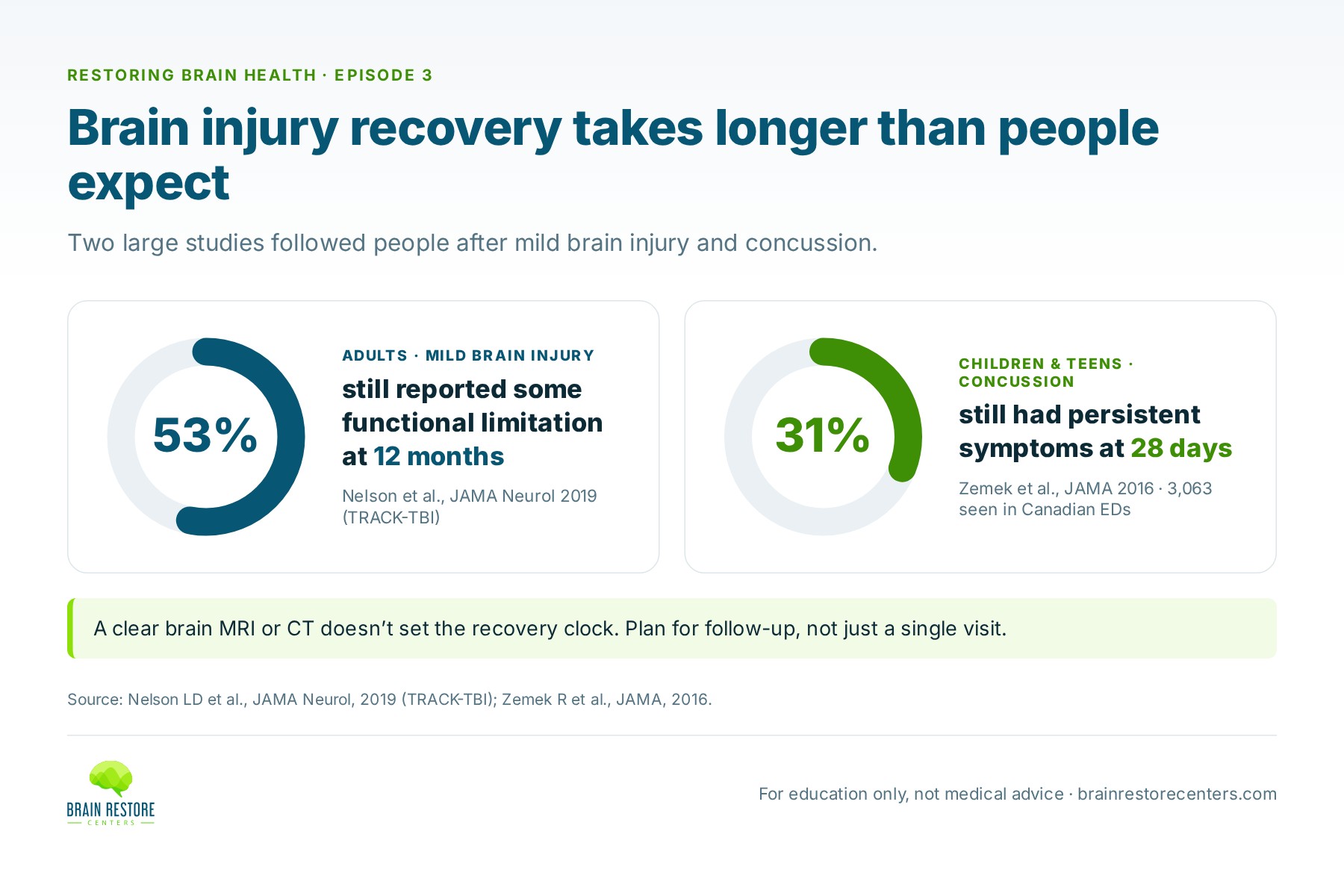
A related TRACK-TBI analysis followed people with mild brain injury for a full year and found that 53% still reported some functional limitation at 12 months. Both research teams called for more systematic follow-up after mild brain injury.
“Just because they’re structurally okay also doesn’t mean they’re functionally okay.”
— Dr. Sharon Webb, on Restoring Brain Health, Episode 3
Why can symptoms show up later?
Dr. Webb points out that even a patient with a very small bleed who seems completely normal can go on to have concussion symptoms, or symptoms “so minor that they don’t notice it at first.” Headaches, trouble concentrating, irritability, poor sleep or feeling foggy may only become obvious when someone returns to work, school or a busy day. Often a spouse, parent or teacher notices before the person does.
What should parents know about kids and concussion?
Children aren’t small adults, and their recovery can take time. A large Canadian study followed 3,063 children and teens seen in nine pediatric emergency departments within 48 hours of a concussion. About 31% still had persistent post-concussion symptoms four weeks later.
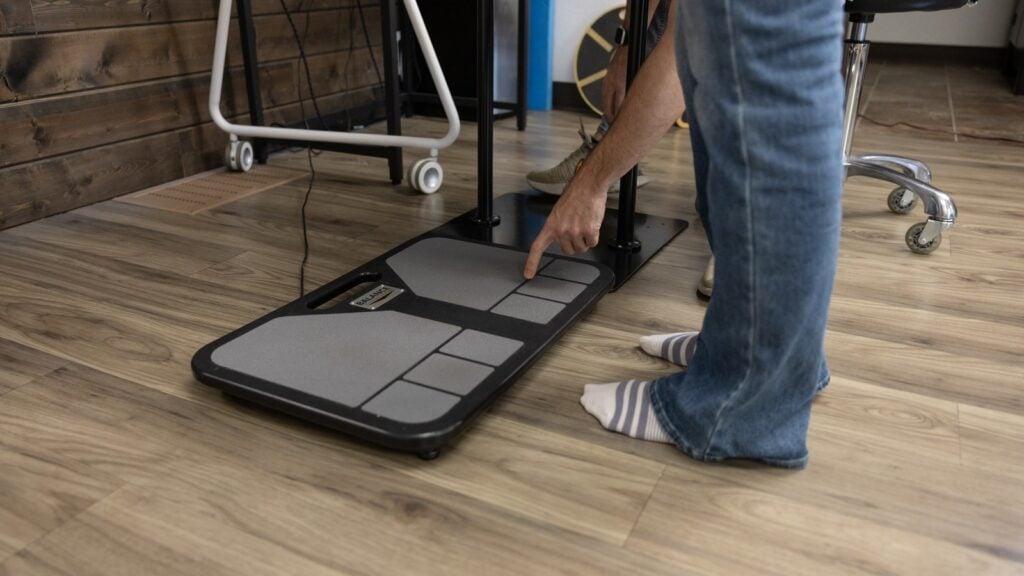
Interestingly, one of the factors the researchers included in their risk score was a simple balance test: making four or more errors standing heel-to-toe. That’s a reminder that functional checks, not just pictures, carry useful information. If your child’s CT was clear but they’re still not themselves weeks later, it’s reasonable to look further.
What should you do after a clear brain MRI or CT?
- Take the good news seriously: nothing dangerous was found.
- Keep your follow-up appointments. TRACK-TBI researchers recommend a check-in about two weeks after a mild injury.
- Track symptoms like headaches, fog, dizziness, light or noise sensitivity, sleep and mood, and tell your doctor if anything changes.
- Ask someone close to you what changes they’ve noticed.
- Get a functional baseline: a neurological exam, balance testing and a qEEG brain map show how your brain is working now, and can be measured again later.
At Brain Restore Centers, when functional testing shows areas of the brain not working together as well as they should, we call it network interference. Network interference is what we call it when testing shows that different areas and networks of the brain aren’t functioning and working together as well as they should. It’s something we measure, not a diagnosis.
When not to wait
After a head injury, a worsening headache, repeated vomiting, increasing confusion, unusual drowsiness or trouble waking, weakness or numbness, slurred speech, or a seizure need emergency care. Call 911.
Frequently asked questions
Should I ask for an MRI if my CT was normal?
Talk with your doctor. MRI can find smaller injuries than CT, and your doctor will weigh your symptoms and history in deciding whether it’s needed.
Does a clear CT mean I don’t have a concussion?
No. Concussion is diagnosed from what happened and from symptoms and exam findings. Most concussions don’t show up on CT at all.
How long after a head injury should symptoms be checked?
Researchers in the TRACK-TBI study recommend a follow-up visit about two weeks after a mild brain injury, and sooner if symptoms worsen.
Go deeper: the photo and the video: what brain imaging shows, and what it can’t, and why one brain test isn’t enough.
Studies referenced
- Yuh EL, Mukherjee P, Lingsma HF, et al. Magnetic resonance imaging improves 3-month outcome prediction in mild traumatic brain injury. Ann Neurol. 2013;73(2):224-235. https://pubmed.ncbi.nlm.nih.gov/23224915/
- Madhok DY, Rodriguez RM, Barber J, et al. Outcomes in patients with mild traumatic brain injury without acute intracranial traumatic injury. JAMA Netw Open. 2022;5(8):e2223245. https://pubmed.ncbi.nlm.nih.gov/35976650/
- Nelson LD, Temkin NR, Dikmen S, et al. Recovery after mild traumatic brain injury in patients presenting to US level I trauma centers: a TRACK-TBI study. JAMA Neurol. 2019;76(9):1049-1059. https://pubmed.ncbi.nlm.nih.gov/31157856/
- Zemek R, Barrowman N, Freedman SB, et al. Clinical risk score for persistent postconcussion symptoms among children with acute concussion in the ED. JAMA. 2016;315(10):1014-1025. https://pubmed.ncbi.nlm.nih.gov/26954410/
Watch the full conversation: Restoring Brain Health, Episode 3.
Find out how your brain is working right now
The first step is a Complimentary Brain Scan at a Brain Restore Center near you: a functional look at how your brain is working today. No pressure, no assumptions. If it looks like we may be able to help, we’ll talk about next best steps.
This article is for education and is not medical advice. It does not replace care from your own doctor. If you have sudden or severe symptoms, such as a sudden severe headache, new weakness or numbness, trouble speaking, or confusion, call 911 or go to the nearest emergency room.