The short answer
Keep working with your doctor, and add information instead of waiting. Write down your symptoms, bring a family member’s observations, ask what your tests were meant to rule out, and get a baseline of how your brain is working now. That gives you something concrete to measure against later.
Hearing “everything looks normal” when you don’t feel normal is frustrating. Often it comes with advice to watch and wait. But as Dr. Chad Woolner says on Episode 1 of Restoring Brain Health, watching and waiting “is, quite frankly, not a real strategy.” Here’s a practical plan you can start this week.
Step 1: Take the good news seriously
A clear CT or brain MRI means no dangerous structural problem was found. That’s worth something. It also means it’s time to ask a different question: not “what’s broken?” but “how well is my brain working?” (Here’s exactly what a normal brain MRI or CT rules out.)
Step 2: Write down your story
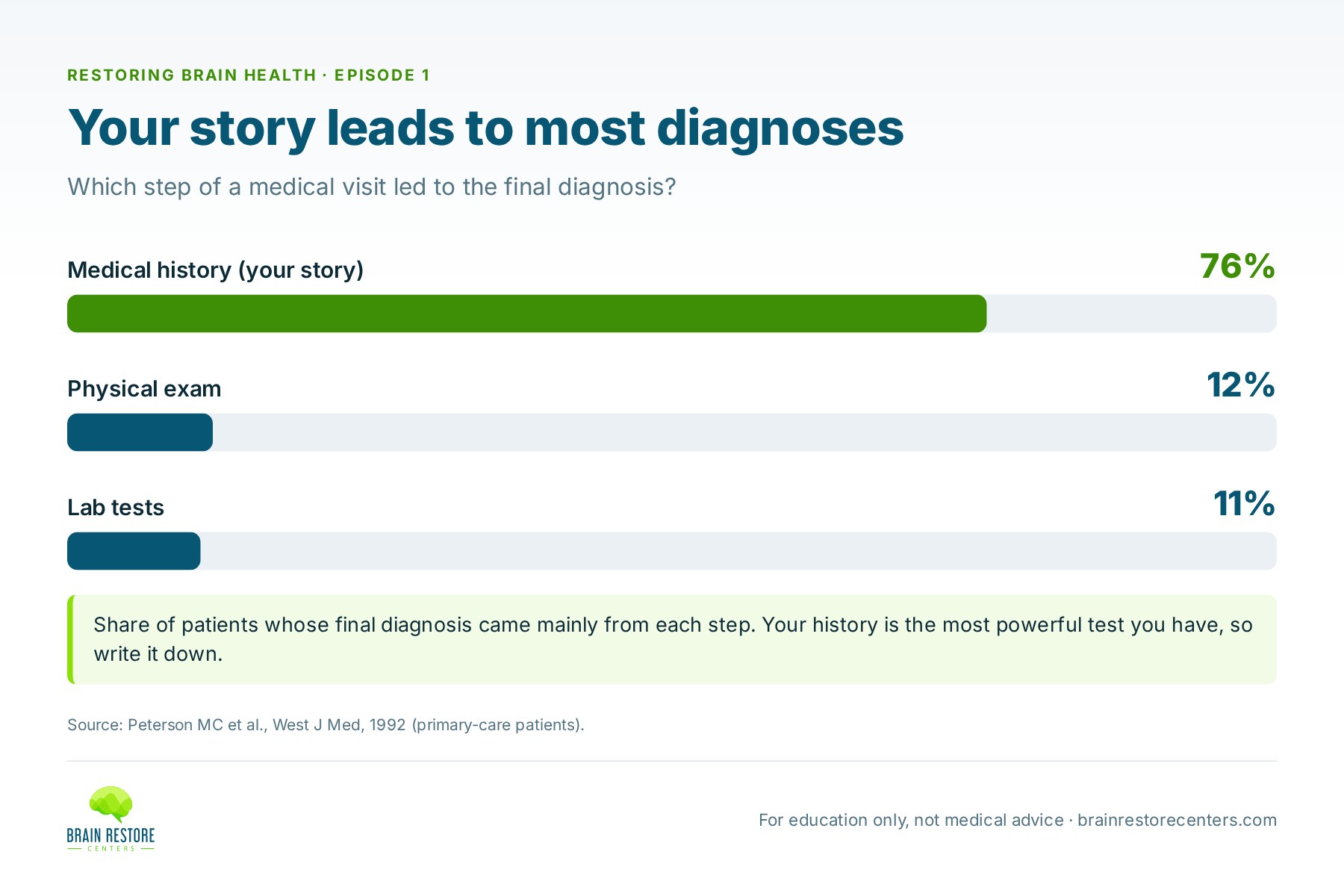
This may be the most underrated step. In a 1992 study, internists recorded their thinking after each stage of a visit with 80 patients who had new or undiagnosed problems.1 The history alone led to the final diagnosis in 76% of patients. The physical exam led to it in 12%, and lab tests in 11%. Tests were still valuable for ruling things out and for confirming, but the patient’s story did most of the work.
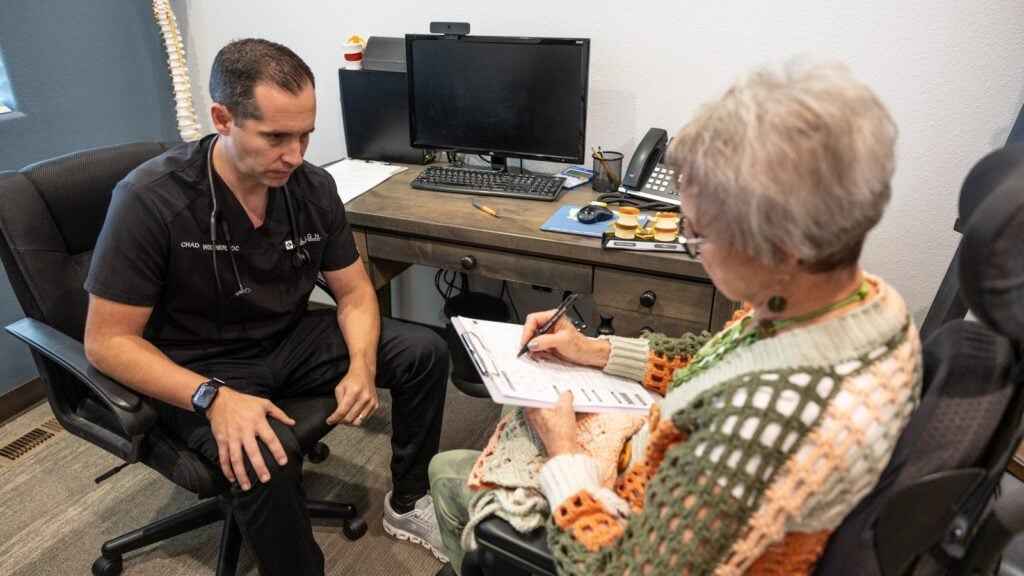
Dr. Berry makes the same point on the episode: “a good physician will start with a good history and a good bedside exam, because we can garner a lot of information from that stuff.” So make your history easy to use. Write down:
- What you notice: fog, word-finding, memory, sleep, balance, mood, focus, headaches, light or noise sensitivity
- When it started, and anything that happened around then (an injury, illness, a stressful season)
- What makes it better or worse, and what time of day it’s worst
- What you’ve stopped doing because of it
Step 3: Ask someone close to you what they’ve noticed
Loved ones often see changes first: repeating the same stories, losing the thread of a conversation, getting overwhelmed more easily, or seeming “not the same person.” Dr. Woolner notes on the show how often families “recognize right in front of them, this person is not the same person.” Their observations count. Bring them.
Step 4: Keep your follow-up appointments
This isn’t either-or. If your doctor wants to see you again in six months, keep that appointment. It keeps an important check in place. Everything else on this list happens alongside it.
Step 5: Ask what your tests were looking for
Knowing what was ruled out helps you see what’s still unanswered. Most imaging answers a structural question. Function is a separate question that needs different tools.
Step 6: Get a functional baseline
A baseline is a snapshot of how your brain is working today that can be repeated later. Instead of waiting to see whether things get worse, you get numbers you can compare over time. A functional assessment usually combines several views:
Balance testing: a window into how the brain coordinates
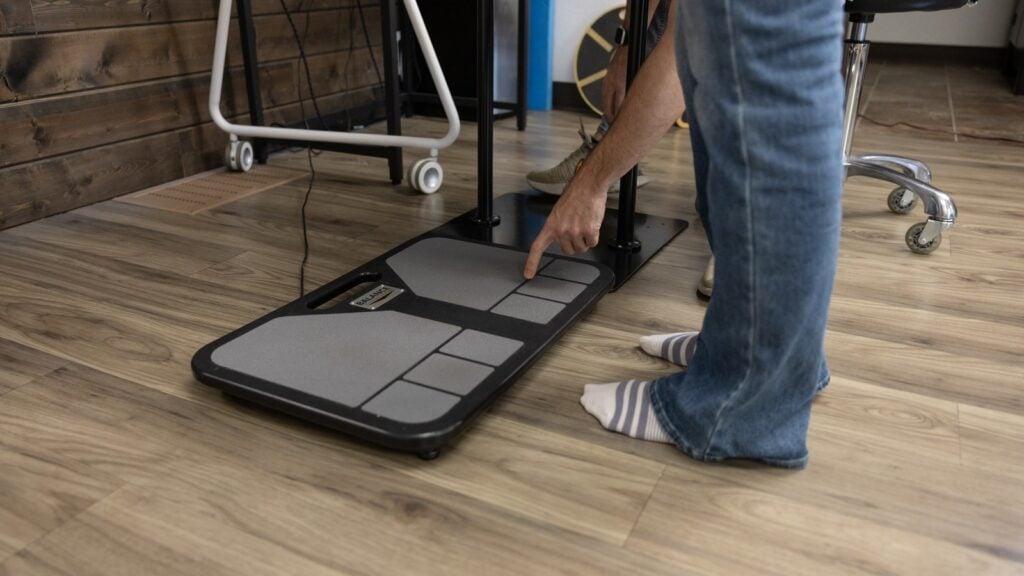
Standing still sounds simple, but your brain is constantly blending signals from your eyes, your inner ear and sensors in your joints and feet. Computerized balance testing uses a force plate to measure tiny shifts in sway while those signals are changed, for example with your eyes closed or on a soft surface.
Researchers have used this kind of testing for years in concussion. A review by Kevin Guskiewicz of the University of North Carolina found that balance testing, with force plates and with simpler clinical tests, picked up balance problems lasting several days after sport-related concussion, and called it a reliable and valid addition to concussion assessment.2 He also noted something important: symptoms, thinking tests and balance don’t always line up. Someone can feel better while balance is still off, or the other way around. That’s why looking from several angles matters.
qEEG brain mapping
A qEEG records the brain’s electrical activity and compares it with people the same age. Learn how qEEG works and what the research shows.
Memory and thinking screens, plus a neurological exam
Standardized screens measure attention, recall and processing speed. A hands-on exam checks reflexes, eye movements, coordination and sensation. Together with your history, these show patterns that no single test could. When testing shows areas of the brain aren’t working together as well as they should, we call that network interference. It’s something we measure, not a diagnosis.
For parents: when a child is still struggling after a concussion
Kids and teens are often told they’ll bounce back, and many do. But not all. A large study of 3,063 children and teens seen in Canadian emergency departments for concussion found that about 31% still had persistent symptoms 28 days later.3 Factors linked to a higher risk included being 13 or older, being female, a history of migraine, a prior concussion with symptoms lasting more than a week, and early signs like headache, fatigue, noise sensitivity, answering questions slowly and making four or more errors on a simple balance test.
Notice that a balance test was one of the useful early signals. If your child is still not back to normal weeks after a concussion, a functional baseline gives you facts to work with instead of more waiting.
“It isn’t that you’re wrong or crazy.”
— Dr. Sharon Webb, on Restoring Brain Health, Episode 1
When not to wait
Some symptoms need emergency care, not a plan. A sudden severe headache, new weakness or numbness, trouble speaking, sudden confusion, repeated vomiting after a head injury, or loss of consciousness: call 911.
Learn more: Why do I still feel off when my tests are normal? and structure vs. function, explained.
Studies referenced
- Peterson MC, Holbrook JH, Von Hales D, Smith NL, Staker LV. Contributions of the history, physical examination, and laboratory investigation in making medical diagnoses. West J Med. 1992;156(2):163–165. PubMed
- Guskiewicz KM. Postural stability assessment following concussion: one piece of the puzzle. Clin J Sport Med. 2001;11(3):182–189. PubMed
- Zemek R, Barrowman N, Freedman SB, et al. Clinical risk score for persistent postconcussion symptoms among children with acute concussion in the ED. JAMA. 2016;315(10):1014–1025. PubMed
Watch the full conversation: Restoring Brain Health, Episode 1.
Find out how your brain is working right now
The first step is a Complimentary Brain Scan at a Brain Restore Center near you: a functional look at how your brain is working today. No pressure, no assumptions. If it looks like we may be able to help, we’ll talk about next best steps.
This article is for education and is not medical advice. It does not replace care from your own doctor. If you have sudden or severe symptoms, such as a sudden severe headache, new weakness or numbness, trouble speaking, or confusion, call 911 or go to the nearest emergency room.