The short answer
Because most standard tests answer one question: is something structurally wrong or dangerous? They aren’t built to measure how well your brain is working. A brain can keep up by working harder, changes can start at a level too small to see, and some processes begin years before routine tests catch them. Feeling off with normal tests is common, and it’s real.
If you’ve been told everything looks fine and you still don’t feel like yourself, you’re in very good company. In a classic study, researchers reviewed the records of 1,000 patients at an internal medicine clinic over three years and tracked 14 common complaints, including fatigue, dizziness, headache, insomnia and numbness. Doctors ordered tests in more than two-thirds of cases. A physical cause was found in only 16%.1
The authors didn’t conclude that patients were imagining things. They concluded that strategies focused only on finding a physical cause “may be inadequate.” That’s an important idea. A test can be completely accurate and still be the wrong tool for the question you’re asking.
On Episode 1 of Restoring Brain Health, the hosts walk through why. Here are five reasons, with the research behind each.
1. Your brain MRI answered a different question
A CT or MRI looks at structure: bone, tissue, bleeding, swelling, masses. It is excellent at ruling out danger. As Dr. Trevor Berry explains on the episode, these tests are “not designed to look at those kind of functional imbalances and that story that your brain’s trying to create.” (For the full breakdown, see what a normal MRI or CT actually rules out.)
2. Some changes are too small to see on imaging
Dr. Sharon Webb, a neurosurgeon, draws the line between “large enough structural damage that we can pick it up” and “small microscopic neurological damage that our conventional tests can’t pick up on, but that functional tests can because it’s affecting function.”
Think of a city’s power grid. From a helicopter, every building and power line is standing. But if a few relay stations are running poorly, the lights flicker all over town. You won’t see that from the air. You see it by measuring the current.
3. Your brain may be compensating, and that’s exhausting
The brain is remarkably good at getting the job done anyway. That’s a strength, but it has a cost. In a study published in Brain, researchers used functional MRI to watch people living with the long-term effects of a brain injury do a simple reaction task.2 They answered accurately, but their responses were slower and less consistent than healthy people of the same age. Their brain activity showed a pattern the authors linked to a higher mental workload.
That matches what people describe at home and at work: “I can still do it, I just have to try so much harder.” Fatigue, irritability, brain fog and needing a nap after a meeting are all signs of a brain that may be spending extra effort to keep up. None of that would show on routine imaging.
4. Some changes begin years before tests catch them
This matters most for people worried about memory. The brain’s structure often stays normal-looking on routine imaging for a long time while other changes are already underway.
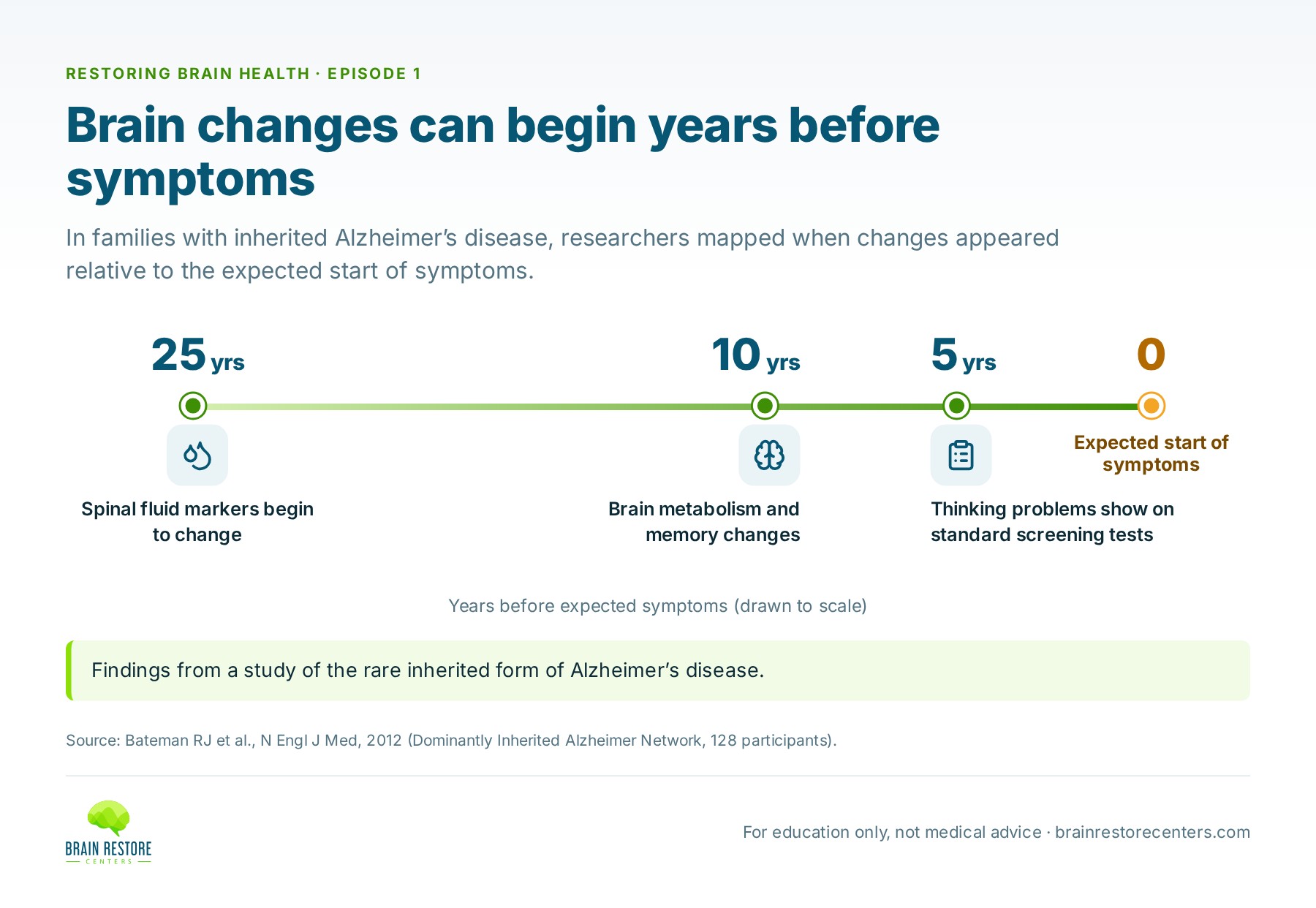
The clearest evidence comes from families with a rare inherited form of Alzheimer’s disease, where researchers can predict roughly when symptoms will start. A study in the New England Journal of Medicine followed 128 people from these families.3 Changes in spinal fluid markers appeared to begin about 25 years before expected symptoms. Changes in brain metabolism and memory showed up about 10 years before, and broad thinking problems on standard screening tests about 5 years before.
This was a special, inherited group, so the exact timeline doesn’t apply to everyone. But it shows a key principle: by the time a routine test turns abnormal, the brain has often been changing for years. Waiting until a test finally confirms a problem means waiting through the years when you could have been paying attention.
Your own sense that something has changed counts too. A meta-analysis of 28 studies and nearly 30,000 older adults found that people with memory complaints, even when standard testing found no objective problem, were about twice as likely to develop dementia over the following years as people without complaints.4 Most people with complaints did not go on to develop dementia. But the finding is clear: noticing a change is worth taking seriously, not brushing off.
5. The symptoms come as a cluster, and nobody has measured function yet
Fog, word-finding trouble, poor sleep, dizziness, mood changes and trouble focusing often travel together. That pattern is a clue. It suggests the issue may be about how networks work together, rather than one spot that’s broken. At Brain Restore Centers, we call this network interference. Network interference is what we call it when testing shows that different areas and networks of the brain aren’t functioning and working together as well as they should. It’s something we measure, not a diagnosis.
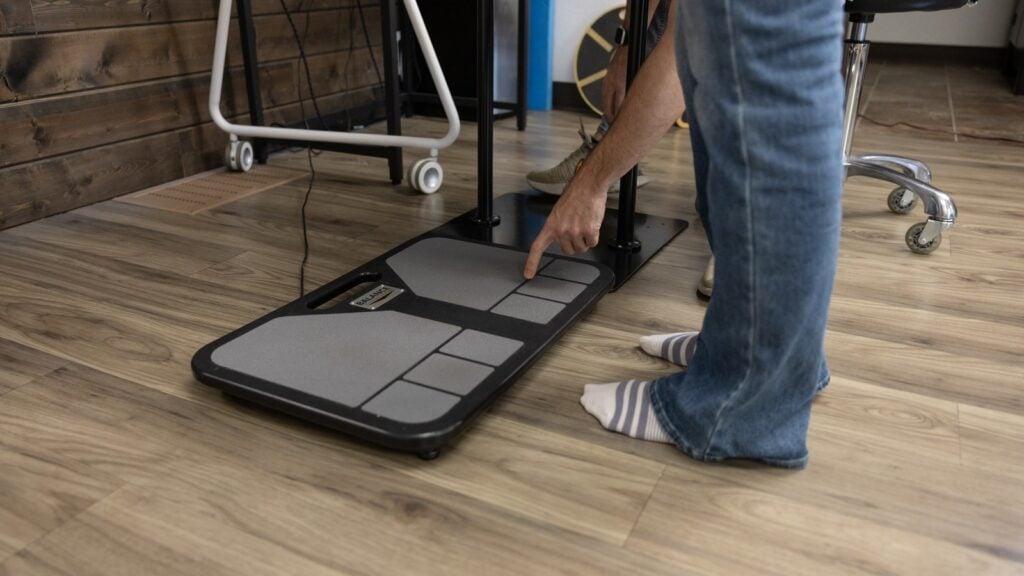
Function can be measured. A qEEG brain map, computerized balance testing, a memory and thinking screen and a neurological exam each look at a different part of how the brain is working. Until someone looks, “normal” only describes structure.
Is it anxiety, or is it my brain?
People in this situation are often told it’s stress. Stress and mood are real and they matter. But they can also travel alongside changes in how the brain is working, and the two can feed each other. It doesn’t have to be one or the other. Measuring function is one way to stop guessing.
“It isn’t that you’re wrong or crazy, it’s that in a conventional doctor’s office, you don’t have the tools to actually measure what’s going on.”
— Dr. Sharon Webb, on Restoring Brain Health, Episode 1
What to do next
- Keep your follow-up appointments with your doctor.
- Write down your symptoms, when they started and what makes them better or worse.
- Ask a family member what changes they’ve noticed. Loved ones often see things first.
- Get a functional baseline. See six practical steps to take after “everything looks normal” and how structural and functional testing compare.
Studies referenced
- Kroenke K, Mangelsdorff AD. Common symptoms in ambulatory care: incidence, evaluation, therapy, and outcome. Am J Med. 1989;86(3):262–266. PubMed
- Sharp DJ, Beckmann CF, Greenwood R, et al. Default mode network functional and structural connectivity after traumatic brain injury. Brain. 2011;134(Pt 8):2233–2247. PubMed
- Bateman RJ, Xiong C, Benzinger TL, et al.; Dominantly Inherited Alzheimer Network. Clinical and biomarker changes in dominantly inherited Alzheimer’s disease. N Engl J Med. 2012;367(9):795–804. PubMed
- Mitchell AJ, Beaumont H, Ferguson D, Yadegarfar M, Stubbs B. Risk of dementia and mild cognitive impairment in older people with subjective memory complaints: meta-analysis. Acta Psychiatr Scand. 2014;130(6):439–451. PubMed
Watch the full conversation: Restoring Brain Health, Episode 1.
Find out how your brain is working right now
The first step is a Complimentary Brain Scan at a Brain Restore Center near you: a functional look at how your brain is working today. No pressure, no assumptions. If it looks like we may be able to help, we’ll talk about next best steps.
This article is for education and is not medical advice. It does not replace care from your own doctor. If you have sudden or severe symptoms, such as a sudden severe headache, new weakness or numbness, trouble speaking, or confusion, call 911 or go to the nearest emergency room.